
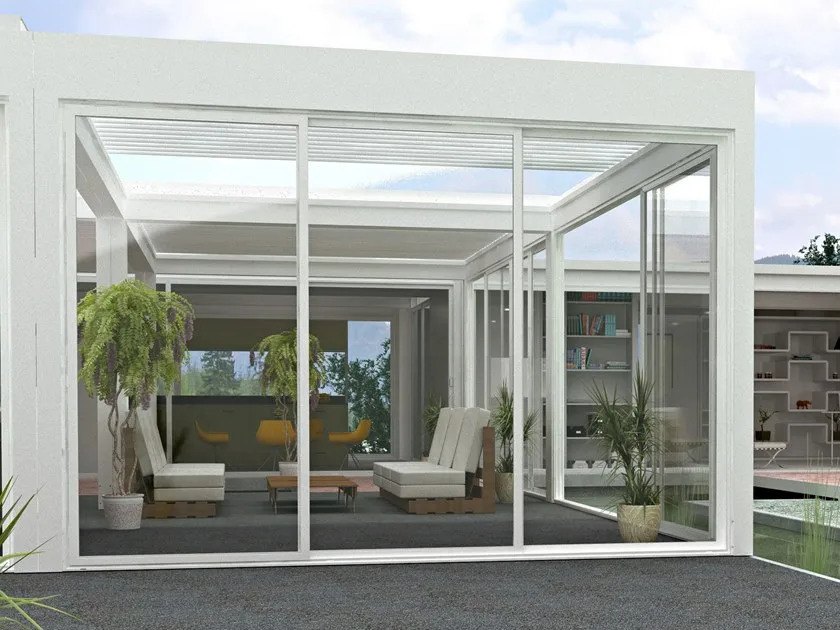
Well, if you ask five people, you might get five different responses. But at its most basic, a sun room is an area that is largely made of glass and where you can sit and still be near the outdoors.
It’s not fully outdoors, and it’s not completely indoors either.
You get the sunlight, the view, and the feeling of being outside, without being outside. That’s why it’s there.
In Dubai, these are typically constructed with large glass windows and aluminium framing so it doesn’t feel too heavy and claustrophobic. When they are well-designed, you can’t really see the structure, just the space.
Most villas already have space. That’s not the issue.
The issue is how much of that space actually gets used. A garden might look great, but it stays empty most of the time. A terrace is there, but no one really sits there unless the weather is right.
That’s where sun rooms start to make sense.
They don’t completely change the space. They make it usable more often. You still have the open space, but it’s now usable.
And once you get that space used, it becomes one of the living areas that you use the most.
This is where it gets interesting, because there are lots of different ways to design a sunroom. The concept is straightforward, but the execution can vary based on the house and its intended use.
Some sun rooms are built as extensions of the house. These feel like your indoor space just continues outward. You’re not stepping into something separate; it feels like part of the home.
This works well when someone wants a bit more usable space without going through a full construction process.
Other setups are more focused on design. These are the ones with big windows, few window frames, and a very modern feel.
These are the ones preferred by people who are concerned about design. The trick is to keep it open and allow as many sunrays in as possible.
Then there are sunrooms designed for everyday use. These are not just for appearance; they’re made to be used regularly.
This is where people sit in the morning, hang out in the evening, or even eat dinner. After a while, it becomes a part of everyday life.
And often it’s about adding a sunroom that doesn’t stand out as separate from the original home.
It’s an extension of the original house. It looks like it’s always been there.
They are usually added to a space where there is some sort of outdoor setting.
The most typical is in gardens, particularly where there are plants. It naturally makes the space feel calmer.
Terraces are another good option, particularly when there’s a view.
Poolside areas also work really well. They already have that relaxed feel, and a sunroom just makes the space more usable.
Sometimes even side areas that were ignored before end up becoming useful.
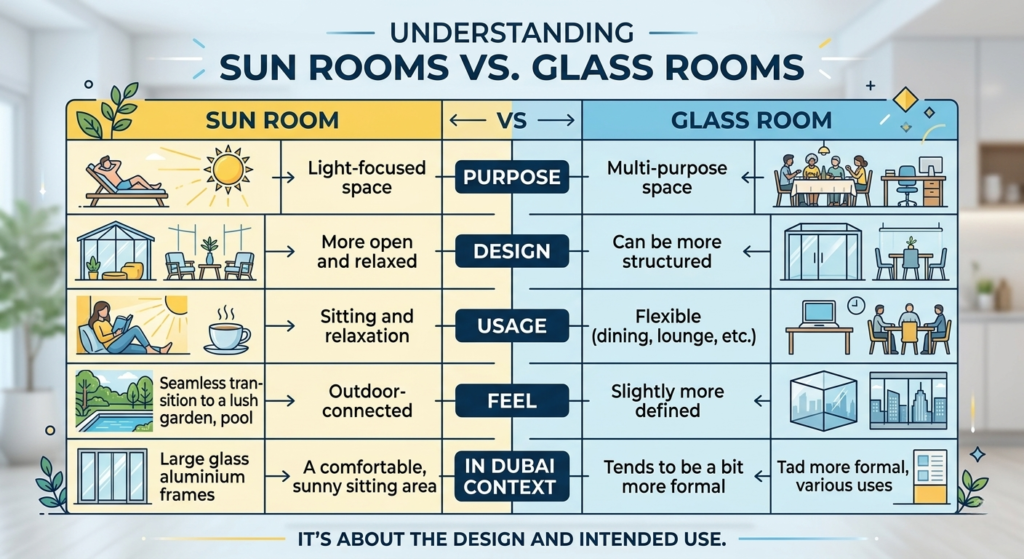
These words are used frequently, and in Dubai, they’re often used interchangeably.
A sun room tends to be a bit more about a comfortable, sunny sitting area.
A glass room can be a tad more formal and have various uses.
However, in real-life projects, there’s not always a clear line. It has more to do with the design and the intended use.
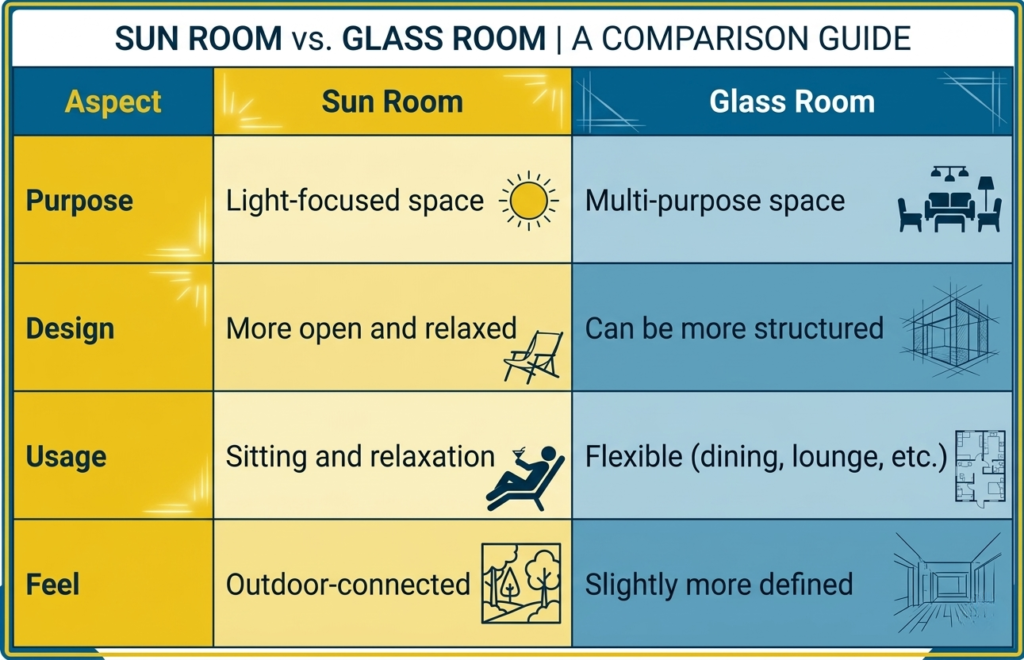
Aspect | Sun Room | Glass Room |
Purpose | Light-focused space | Multi-purpose space |
Design | More open and relaxed | Can be more structured |
Usage | Sitting and relaxation | Flexible (dining, lounge, etc.) |
Feel | Outdoor-connected | Slightly more defined |
It’s the most common question.
A sun room is not a room that is fully enclosed. If that is what people expect, it won’t make sense.
Instead, the real question is how it is designed, where the sunlight will come through, how open the structure is, and how the furniture and other things are placed.
If these things are done right, the space will be used a lot.
If they aren’t, the sunroom will be avoided.
You’ve probably noticed this without thinking about it.
Some look great in pictures but don’t feel as good in real life.
Most of the time, it’s not because of the materials. It’s because of small design choices.
The structure might feel slightly heavy. The alignment might not match the house properly. The sunlight might come in too harshly.
Individually, these don’t seem like big issues. But together, they change how the space feels.
That depends on what you expect from it.
If you already have outdoor space that you don’t use much, then yes, it can make a noticeable difference.
It turns something you ignore into something you naturally start using.
But if the area itself doesn’t feel open or inviting, then adding a sunroom won’t completely fix that.
People are starting to think differently about their homes.
Instead of adding more rooms, they’re improving the spaces they already have.
Sunrooms fit perfectly into that idea.
They don’t feel like a major construction project. They don’t take away from the openness of the house. They just make the space easier to use.
A sun room isn’t about adding something new.
It’s about making an existing space feel more usable, without losing what made it good in the first place: the sunlight, the openness, and the view.
And that’s why more people are starting to go for it.
It’s a glass-based space where you can sit and enjoy sunlight and views without being fully outside.
They’re becoming more common, especially in homes with outdoor areas that aren’t used regularly.
Not really. It stays open and connected to the outside rather than being fully sealed.
In most cases, yes, as long as there’s enough space to work with.