How to Choose Glass Doors and Windows for Your Dubai Villa

How to Choose Glass Doors and Windows for Your Dubai Villa

Most Dubai villa owners get this wrong the first time. They pick glass doors and windows based on how they look in a showroom and then spend the next two summers dealing with rooms that get uncomfortably hot, doors that drag and bind, and frames that start chalking or peeling by year three.

The mistake is not the style choice. It is choosing a product that looks right without knowing whether it is specified correctly for a Dubai villa. A sliding door that performs well in a north-facing living room in The Meadows behaves completely differently on a west-facing wall in DAMAC Hills during a July afternoon. The glass type, the frame profile, the seal quality, and the orientation of the opening all determine whether your investment works or becomes a problem..

TL;DR

  • The direction your opening faces determines your glass specification — north-facing works with standard double-glazed glass, west and south-facing needs Low-E solar control glass in a thermal break aluminium frame.
  • Without the right specification on a west-facing wall, the room becomes unusable from June through September regardless of how hard the AC runs.
  • Sliding doors open 50 percent of the wall span — bifold and stackable systems open 80 to 90 percent, making them the better choice for garden and pool connections.
  • Costs run from AED 680 per sqm for standard aluminium windows to AED 5,500 per sqm for frameless folding doors at full specification.
  • Always get glass type, frame profile, and hardware itemised separately before committing to any quote.

This guide covers every decision you need to make, from glass type to frame material to door system so you choose correctly the first time

Table of Contents

Why Glass Doors and Windows Behave Differently in Dubai Than Anywhere Else

Dubai’s climate is not a minor consideration when choosing glazing. It is the defining factor in which products work and which ones fail within a few years.

Three conditions in the UAE create requirements that simply do not apply in temperate markets. The first is heat intensity. Dubai summers push temperatures past 45 degrees , and surface temperatures on south and west-facing glass in direct afternoon sun go significantly higher. Standard glass that performs perfectly in the UK or Europe develops thermal stress at these surface temperatures. Tempered glass does not. That is why tempered glass is the minimum specification for any structural glazing in Dubai, not an upgrade.

The second is UV exposure. Dubai sits at latitude 25 degrees north, which means the sun angle is high and UV intensity is sustained across most of the year. UV exposure is what causes powder coat finishes to chalk and peel, what degrades rubber seals and gaskets, and what causes standard glass to develop surface etching over time. UV-stabilised materials and coatings rated for the UAE climate are not optional extras.

The third is sand and coastal humidity. Fine desert sand enters every unsealed gap in a frame channel. If the brush seals and gaskets around your sliding or bifold door panels are undersized or poorly fitted, sand works into the track within weeks of a sandstorm season and the panels start to drag. For villas in Dubai Marina, JBR, Palm Jumeirah, and Jumeirah Beach, coastal salt air adds a corrosion risk that standard steel fixings and fittings cannot handle for long.

Understanding these three conditions is the starting point for every specification decision that follows.

Which Direction Does Your Opening Face? Start Here.

Before choosing a glass type, a door system, or a frame profile, the single most important question to answer is which direction your opening faces. This determines everything else.

A north-facing glass door or window in Dubai receives no direct sun at any time of year. It gets consistent, comfortable indirect daylight. You can specify standard double-glazed glass in a thermal break frame and the space will perform well year-round. North-facing openings are the easiest to work with and the most forgiving of specification decisions.

East-facing openings get direct morning sun, which is intense but less sustained than afternoon sun. Double-glazed Low-E glass handles this well. The morning heat load is manageable with a standard air conditioning setup for most room sizes.

South-facing openings receive lower-angle sun in both morning and afternoon. The heat load is moderate but present throughout the day. Double-glazed Low-E glass with solar control coating is the correct call for south-facing walls with large glazed areas.

West-facing openings are the most demanding. They receive direct, intense afternoon sun from roughly 1pm to 7pm during a Dubai summer, the hottest part of the hottest day. A west-facing glass wall without the right glass specification makes the room adjacent to it unusable from June through September regardless of how hard the AC runs.

For west-facing openings, the minimum correct specification is double-glazed Low-E glass with solar control coating in a thermally broken aluminium frame. Thermal break aluminium adds 15 to 20 percent to the frame cost but saves significantly on DEWA over the lifetime of the installation. The payback on the thermal break alone for a west-facing opening in a Dubai villa is typically under two years through reduced cooling costs.

Glass Types for Dubai Villas : What Each One Does

What is single-pane tempered glass and when should you use it?

Single-pane tempered glass is one sheet of heat-treated glass. Tempering makes it four to five times stronger than standard annealed glass and changes how it breaks into small blunt fragments rather than sharp shards. This is the minimum safety specification for any glass door or structural glass panel in Dubai.

Single-pane tempered glass has no thermal performance. It does not reduce heat transfer or sound. It is the correct choice for interior glass partitions, shower enclosures, and openings that receive no direct sun and where acoustic performance is not a requirement. For any exterior door or window facing significant sun exposure in a Dubai villa, single-pane tempered glass is not sufficient on its own.

What is double-glazed glass and why does Dubai need it?

A double-glazed glass unit, also called an insulated glass unit or IGU consists of two glass panes with a hermetically sealed gap between them, usually filled with argon gas. The sealed gap acts as a thermal and acoustic barrier across the full glass face.

Double-glazed windows reduce heat gain through the glass face by 30 to 50 percent compared to single-pane glass, and they reduce sound transmission significantly. For a Dubai villa near a major road like Al Khail Road, Sheikh Zayed Road, or Emirates Road, the acoustic reduction is often as important as the thermal performance.

The payback period for double-glazed window replacement in a typical Dubai villa runs between 18 and 36 months through lower DEWA bills alone. For a villa with multiple west and south-facing windows, the saving in the first full summer can be substantial

What is Low-E glass and when is it the right choice?

Low-E glass has a microscopic metalite coating applied to one surface of the glass. This coating reflects infrared radiation, the heat component of sunlight  before it passes through the glass, while allowing visible light to come through.

The result is a glass that looks almost identical to standard clear glass from the inside but keeps the room significantly cooler. In a Dubai villa, the right Low-E specification keeps interiors 8 to 15 degrees cooler than the same room with single-pane glass, which directly reduces the load on your air conditioning system and your DEWA bill.

Low-E glass is the correct choice for any south or west-facing opening in a Dubai villa with large glazed areas. It is also the right specification for glass rooms, conservatories, and skylights where solar heat gain is a direct concern. Combined with double glazing in a thermally broken frame, Low-E glass is the highest-performing residential specification for Dubai conditions.

What is laminated glass and where is it required?

Laminated glass bonds two or more panes together with a PVB or SGP interlayer under heat and pressure in an autoclave. If the glass breaks, the interlayer holds every fragment in place. The panel cracks but stays in the frame.

This post-breakage behaviour is what makes laminated glass the required specification for overhead glazing, skylights, glass floors, staircase balustrades, and any application where a broken panel falling would create a safety hazard. It is also the base specification for acoustic glass, bullet-resistant glass, and blast-resistant glass.

For Dubai villa applications, laminated glass is required for any skylight or glass roof panel, for staircase and balcony glass balustrades above a certain height, and for overhead glass canopies above walkways or entrances.

Door System Types for Dubai Villas : Choosing the Right One

The glass type and the door system are separate decisions. Once you have the glass specification right, the door system type determines how the opening functions, how much of the wall it clears, and how much wall space it needs.

Here are the most common systems for Dubai villa applications:

  • Sliding doors open by moving one or more panels along a track. A standard two-panel sliding door opens 50 percent of the wall span. Best for frequent access points, balcony connections, and openings where bifold is not needed.
  • Bifold and stackable doors fold or slide and stack against one side of the opening. They clear 80 to 90 percent of the wall span, making them the best choice for connecting a living room to a garden or pool. The panels need space to park on one or both sides.
  • Telescopic doors use a door-on-door mechanism where multiple panels stack compactly in limited wall space. Best for wide openings with restricted wall space beside them.
  • Frameless folding doors use pivot hinges with no visible perimeter frame. The highest-specification finish for luxury villa projects where unobstructed views and minimal visual frame are the priority.

Each system has a different maintenance requirement in Dubai. Sliding door tracks need monthly sand clearing. Bifold hinges and pivot points need six-monthly lubrication with the correct lubricant, not WD-40, which attracts dust. Telescopic carriage systems need annual roller checks.

Frame Materials — Why Aluminium Dominates Dubai Villas

Aluminium is lightweight, strong, and rust-resistant ideal for Dubai’s climate. It accepts powder coat in any RAL colour, holds its shape under thermal stress, and lasts 25 to 30 years with minimal maintenance when correctly installed. This is why aluminium frames are used in the overwhelming majority of residential glass door and window installations across Dubai villa communities.

The critical distinction to make when specifying aluminium for a Dubai villa is between standard aluminium profiles and thermal break aluminium profiles.

A standard aluminium profile is a single continuous piece of metal. Heat travels through metal easily. In a Dubai summer, the outer face of a frame in direct sun reaches surface temperatures that transfer through the profile to the inner face and raise the room temperature around the frame. For small windows, this effect is manageable. For large sliding door walls, glass rooms, and full-height windows, it adds measurable heat load to the space.

A thermal break profile has a polyamide barrier bonded into the centre of the extrusion that physically separates the outer aluminium from the inner aluminium. The outer face gets hot. The inner face stays significantly cooler. For any large glazed opening in a Dubai villa, thermal break is the correct base specification.

uPVC is used in some Dubai applications, particularly for smaller windows where cost is a priority. It offers good thermal performance but does not handle large spans as well as aluminium, and its appearance over 10 to 15 years in Dubai’s UV intensity is notably different from aluminium. For villa doors and large windows, aluminium is the correct choice.

What Does It Cost? Real AED Figures for Dubai Villa Glass Doors and Windows

Cost is the question every homeowner has before the second conversation. Here are real figures based on current Dubai market pricing:

Aluminium windows start from AED 680 per square metre for standard configurations.</cite> Double-glazed units with thermal break frames run from AED 900 to AED 1,400 per square metre. Custom configurations, premium finishes, and large-format panels add to this figure.

For sliding glass doors, standard configurations with double-glazed glass start from AED 1,200 to AED 1,800 per square metre. Bifold and stackable systems with thermal break frames and Low-E glass run from AED 1,800 to AED 3,000 per square metre for residential villa applications.

Frameless folding door systems at the premium end of the market run from AED 3,500 to AED 5,500 per square metre for fully specified luxury villa installations.

The four biggest factors that move the price are glass specification, thermal break inclusion, hardware quality, and powder coat colour. Standard RAL colours are typically included in base pricing. Custom RAL colours add cost. Hardware with multi-point locking, soft-close mechanisms, and anti-jump devices adds more, but these are the components that determine whether the installation still operates correctly after five years of daily use in Dubai’s conditions.

Always ask your contractor to itemise the glass specification, frame profile, hardware grade, and powder coat specification separately in the quote. A lower quote that uses single-pane glass in a standard frame is not a comparable product to a higher quote that uses double-glazed Low-E glass in a thermal break frame.
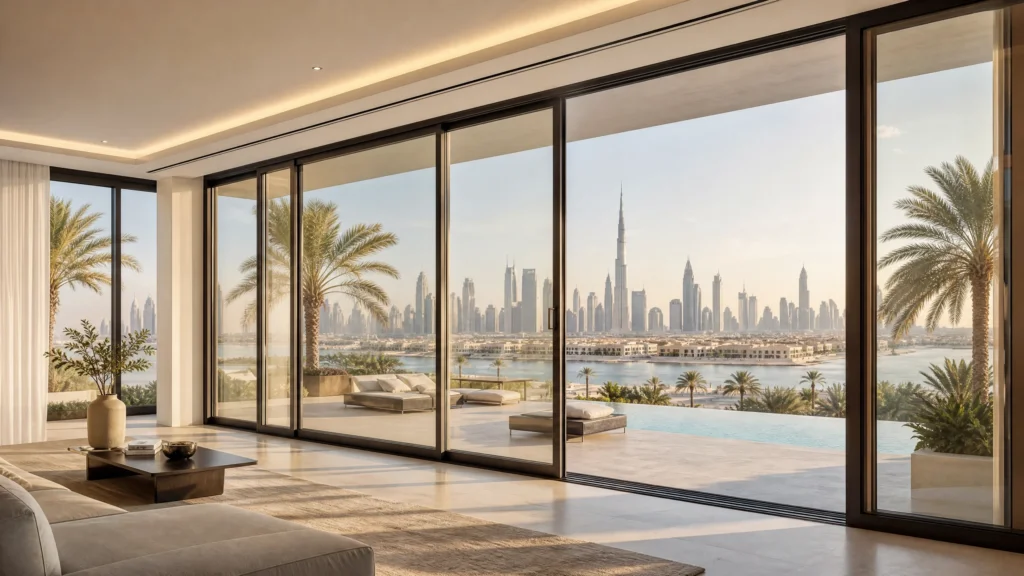

Window Types for Dubai Villas — The Right Style for Each Room

Not every room in a Dubai villa needs the same window type. Choosing the right configuration for each space is as important as the glass specification.

Casement windows open on a side hinge like a door. They create one of the strongest perimeter seals of any openable window type, which makes them particularly effective for acoustic and thermal performance. They are well-suited to bedrooms and rooms where air circulation matters when open but strong weather sealing is needed when closed.

Fixed-light windows do not open at all. They provide the best thermal and acoustic performance of any window type because there are no moving seals or gaps. They are the correct choice for rooms where ventilation happens through other means and the priority is light and view without heat gain.

Sliding windows work well for balconies and narrow wall openings where a casement would swing into a space. They require good track sealing in Dubai to prevent sand entry.

Tilt-and-turn windows are a premium European mechanism that tilts at the top for ventilation or swings open fully from the side. They create one of the strongest seals against air and sound leakage of any openable window and are popular in villas near major Dubai road corridors where noise reduction is a priority.

What to Ask Before You Choose an Installer in Dubai

Choosing the right installer matters as much as choosing the right product. Here are the questions that will tell you what you need to know before committing.

  • Does the company fabricate in-house or subcontract? In-house fabrication means they control the quality of the frame from the extrusion stage. Subcontracted fabrication means they are passing on another supplier’s product.
  • What glass specification do they recommend for your specific opening direction? A company that recommends the same glass for every opening regardless of orientation is not thinking about your specific conditions.
  • What powder coat dry film thickness do they apply? The correct specification for UAE UV exposure is a minimum of 60 microns. Below this, the coating begins to chalk and peel within three to five years.
  • What does the warranty cover and for how long? Material warranties and workmanship warranties are separate. Ask for both in writing.

Elegant Rooms visits your villa, assesses each opening’s orientation and use, specifies the correct glass and frame for each position, and gives you a clear itemised quote before any work begins. In-house fabrication at our Sharjah factory means quality control happens before the material reaches your site.

FAQs

What glass is best for villa windows in Dubai?

Double-glazed Low-E glass in a thermal break aluminium frame. It reduces heat gain by 30 to 50 percent, cuts noise, and lowers DEWA bills. For west and south-facing openings, add a solar control coating for direct afternoon sun.

Single-glazed has one pane with no thermal barrier. Double-glazed has two panes with a sealed argon-filled gap that insulates against heat and noise. In Dubai, double-glazed reduces heat gain by 30 to 50 percent. Payback through lower DEWA bills typically runs 18 to 36 months.

For large windows and doors facing south or west, yes. A standard aluminium frame conducts heat from outside to inside. A thermal break frame has a polyamide barrier inside the extrusion that stops that transfer. It adds 15 to 20 percent to frame cost but pays back through reduced cooling load.

Standard aluminium windows start from AED 680 per sqm. Double-glazed thermal break systems run AED 900 to AED 1,400 per sqm. Sliding glass doors start from AED 1,200 per sqm. Bifold systems run AED 1,800 to AED 3,000 per sqm. Frameless folding doors run AED 3,500 to AED 5,500 per sqm.

Double-glazed Low-E glass in a thermally broken aluminium frame with stainless steel hardware and quality brush seals. For coastal areas like Marina, JBR, and Palm Jumeirah, coastal-rated powder coat is essential. For very wide openings, a telescopic or bifold system gives a larger clear opening than a standard slider.

Correctly specified and installed, 25 to 30 years without structural degradation. Brush seals, rollers, and locking mechanisms wear first but can all be replaced without changing the frame or glass. Annual track cleaning and six-monthly lubrication extend operational life significantly.

Casement and tilt-and-turn windows create the strongest perimeter seals of any openable type. Combined with double-glazed acoustic laminated glass, they reduce road traffic and construction noise significantly. Fixed-light windows with acoustic glazing perform best for rooms where ventilation comes from other sources.

Start With the Right Conversation

The decision about glass doors and windows for your Dubai villa is not one to make in a showroom or from a catalogue price list. It depends on which direction each opening faces, how each room is used, what your DEWA bills look like now, and what performance you need from each part of the building envelope.

Elegant Rooms visits your villa across all Dubai communities, assesses each opening individually, and recommends the correct glass type, frame profile, and door system for your specific conditions. The site visit is free. The quote is itemised. No work starts until you are confident in what you are getting and why.

Connect With Our Experts Instantly.

Copyright © 2025 Elegant Rooms 

Connect With Our Experts Instantly.