
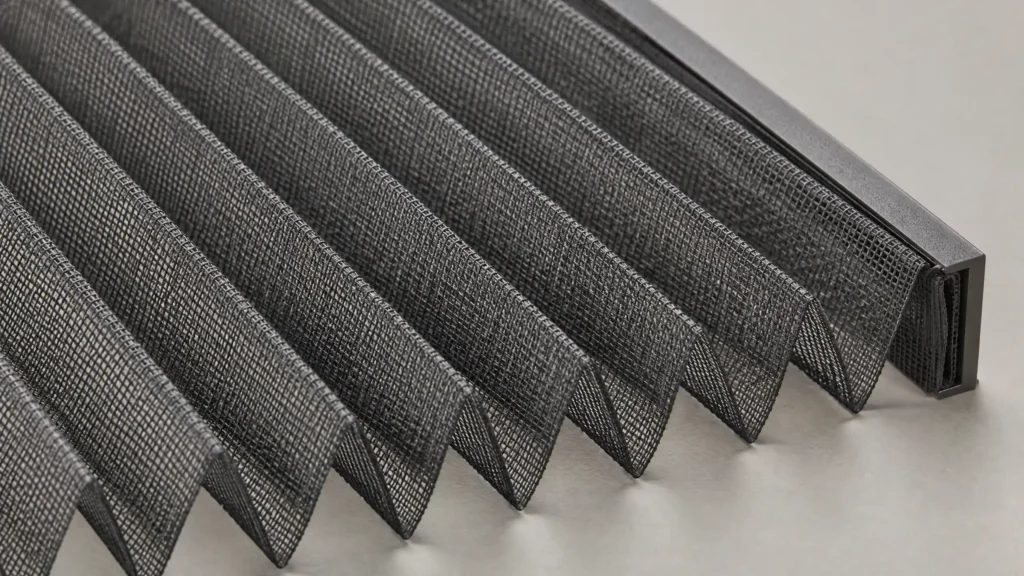
A pleated mesh screen (plissé insect screen) is a retractable, spring-free fly screen crafted from accordion-folded UV-stabilised polyester fabric inside a powder-coated aluminium frame, designed to span wide bifold and sliding patio doors up to 8 metres while folding flat into a side cassette when open.
Investing in pleated mesh for bifold and sliding doors solves the biggest problem UAE homeowners face during cooler months: letting fresh breeze inside without inviting mosquitoes, flies, and desert dust into the living room. Unlike spring-loaded roller screens that snap back violently or fixed screens that block half your patio opening, a pleated (plissé) screen folds like an accordion into a slim 25mm to 40mm side cassette. It spans openings up to 8 metres wide, runs on a low-profile 7mm barrier-free floor guide or caterpillar chain that resists sand build-up, handles 45°C+ Dubai summers without sagging, and installs with or without drilling across villas and apartments.
You spent thousands of dirhams installing wide bifold glass walls or sliding patio doors in your Dubai villa to connect your living room with the garden. Yet for five months of the year—right when UAE weather hits a pleasant 22°C between October and April—you keep those glass doors shut. Why? Because the moment you slide them open in communities like Arabian Ranches, Jumeirah Village Circle (JVC), or Palm Jumeirah, mosquitoes, houseflies, and windblown sand rush straight indoors.
A pleated mesh screen—also known in European manufacturing as a plissé screen door—is a retractable insect barrier made of crisp, zigzag-folded fabric that slides horizontally across a door frame like a harmonica. Instead of rolling around a spring-loaded tube, the mesh folds neatly into crisp 15mm to 20mm pleats that stack inside a vertical aluminium side profile when you open the door.
The relationship between the screen components determines how smoothly the unit glides. An extruded 6063-T5 aluminium frame mounts to the outer reveal of your existing bifold or sliding door. Inside that frame, horizontal Kevlar tension cords run through the pleated UV-stabilised polyester mesh, linking the pull bar to either a flat bottom guide rail or an articulated caterpillar chain. Because there is no coil spring pulling the fabric backward, the screen stays in the exact position you leave it.
Pleated mesh is the best match for wide bifold and multi-panel sliding doors because it covers single spans up to 3 metres and double central-meeting spans up to 8 metres without requiring fixed middle support bars. When you fold back a 5-panel bifold door in a Dubai Hills or Emirates Hills villa, you want an open, uninterrupted walkway to your patio or pool deck.
Fixed sliding fly screens only cover one panel at a time, leaving a visible metal frame permanently sitting across your glass. Pleated mesh mirrors the exact movement of your bifold door. When you stack your glass panels to the left, you slide the pleated mesh into its left-hand
A spring-free pleated screen outperforms traditional roller screens by eliminating internal torsion springs, which allows the door to stop at any point along the track without snapping back. Spring-loaded roller screens rely on high mechanical tension to wind flat fibreglass mesh into a barrel. Over a wide 2-metre patio door, that spring requires significant force to pull closed, and if a child or guest lets go of the handle, the bar shoots back and slams into the housing.
Pleated systems operate on balanced cord tension rather than spring recoil. You can slide the screen open 40 centimetres to let your cat outside or step onto the balcony, and the handle stays right where you left it. Even better, the zigzag folds create a visible three-dimensional pattern, which stops toddlers and pets from accidentally running through the closed screen—a frequent accident with flat, nearly invisible roller mesh.
Modern pleated doors use one of two internal drive mechanisms to guide the bottom of the screen: a caterpillar chain system or a silent rope-tensioned system. Standard pleated doors use an articulated plastic caterpillar chain that rolls out of the vertical pull bar and lays flat inside a shallow floor guide as you close the screen. It handles heavy foot traffic well and works best on wide garden entrances.
For bedrooms and quiet living rooms, European systems like the KeJe Splendid design replace the bottom chain with a noiseless rope-tension mechanism. Because rope tension removes the clicking sound of chain links folding over each other, the door glides in near silence while keeping the mesh taut from top to bottom.
Low-profile and barrier-free pleated mesh tracks handle UAE desert sand by replacing deep U-shaped bottom channels with flat 3mm to 7mm surface guides that windblown dust cannot clog. Traditional sliding screen doors run on rollers inside a 25mm to 35mm raised bottom rail. In Dubai, Abu Dhabi, and Sharjah, desert sand settles inside those deep grooves within weeks, grinding against the bottom wheels until the door jams or derails.
Pleated screens solve both the sand problem and the tripping hazard at the same time. The bottom guide rail is a flat, bevelled strip no thicker than a coin (typically 5mm to 7mm high) fixed to the threshold with weatherproof adhesive. Wheelchairs, baby strollers, and bare feet pass right over it without catching.
Pleated Mesh withstands Dubai’s 45°C+ summer heat, coastal humidity, and high-rise winds because it uses UV-stabilised polyester fabric, 6063-T5 powder-coated aluminium, and internal Kevlar wind-retention cords. Standard PVC-coated fibreglass mesh becomes brittle when exposed to direct Arabian Gulf sunlight, tearing along the frame edges after one or two summers.
High-grade Italian and German pleated mesh fabrics use heat-set polyester or polypropylene with an 18×16 or 20×20 weave density. This weave blocks small sandflies and mosquitoes while allowing 85% natural airflow so you can switch off your air conditioning during winter and lower your monthly DEWA bill. Meanwhile, horizontal Kevlar cords spaced every 30 centimetres prevent the mesh from blowing out of its frame when strong gusts hit high-floor balconies in Dubai Marina, JBR, or Downtown Dubai.
Feature / Specification | Pleated Mesh (Plissé) Screen | Spring-Loaded Roller Screen | Fixed Sliding Frame Screen |
Maximum Opening Width | Up to 8.0m (Double Panel) | Up to 1.8m (Single) / 3.2m (Double) | Up to 2.4m (Requires 2-track frame) |
Operating Mechanism | Spring-free cord / Caterpillar chain | High-tension coil spring | Bottom rollers in deep channel |
Bottom Track Height | 3mm to 7mm (Barrier-free) | 20mm to 30mm enclosed channel | 25mm to 40mm raised rail |
UAE Sand & Wind Performance | High (Kevlar cords, flat track) | Low (Mesh blows out of side rails) | Medium (Sand jams bottom rollers) |
Typical UAE Price Range | AED 750 – AED 2,400+ (Size dependent) | AED 650 – AED 1,400 | AED 450 – AED 950 |
As the comparison shows, while fixed screens cost less upfront for small openings, pleated mesh is the only system that scales past 3.2 metres without introducing tripping hazards or spring failures.
A slimline pleated frame fits tight door recesses without drilling by using narrow 13mm to 28mm aluminium profiles mounted with industrial heat-resistant acrylic tape or clip brackets. One of the biggest headaches with bifold doors is hardware clearance. Bifold systems have protruding D-handles, hinged knuckles, and magnetic catches that stick out into the door reveal.
If an installer uses a bulky 50mm screen cassette, your bifold door handles will hit the screen frame every time you fold the glass panels open. Specialized narrow pleated systems—such as 13mm micro profiles or 22mm mid-profiles—tuck neatly into shallow window and door recesses, clearing both bifold handles and exterior roller shutters.
Yes, installers mount pleated mesh frames onto existing aluminium door reveals using high-bond, heat-resistant double-sided acrylic tape or tension clips, leaving zero screw holes or structural damage on rented villa doors.
A single-panel pleated screen covers openings up to 3 metres wide, while a double central-meeting pleated system spans wide bifold and sliding patio doors up to 8 metres wide by 4 metres high.
Custom pleated mesh doors in the UAE start from AED 700 to AED 950 for a standard single patio door and range up to AED 2,400+ (plus 5% VAT) for wide multi-panel bifold openings.
No, you should never oil or grease a pleated screen track in the UAE because wet lubricants trap desert sand and form an abrasive paste that snaps the internal tension cords.
Clean pleated insect mesh every few weeks by running a soft brush attachment on your vacuum cleaner along the bottom guide rail and wiping the antistatic folds with a damp microfibre cloth and 30°C water.
No, charcoal and grey pleated mesh uses a fine 20×20 weave that preserves over 80% of your outdoor garden visibility while cutting harsh solar glare and maintaining full cross-ventilation.
Yes, pleated screens are safer for children and pets than roller screens because the spring-free bar cannot slam shut, the 7mm bottom track prevents tripping, and the zigzag folds are visually obvious so pets do not run into them.
Upgrading your bifold and sliding doors with pleated mesh turns your living room into an open-air lounge throughout the UAE winter without letting a single mosquito inside. Before requesting quotes from local fabricators, measure the rough width and height of your door opening in millimetres, check whether your bifold panels stack inside or outside the room, and note the RAL colour code of your existing aluminium frames. Book a free on-site measurement with a UAE fly screen specialist who brings physical mesh and frame samples to your villa, verifies your handle clearance depth, and provides a 5-year warranty on the aluminium hardware.