
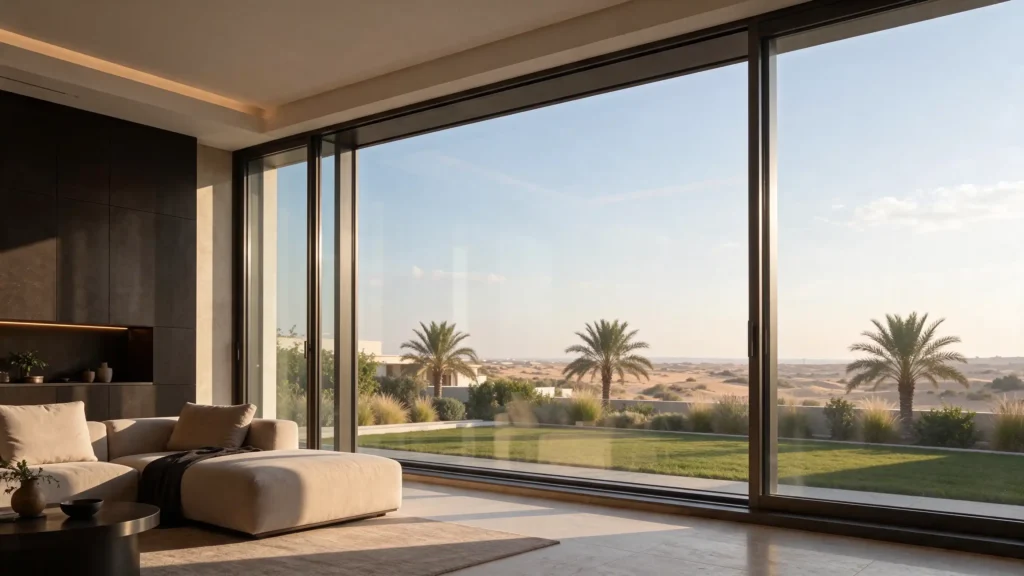
The wrong window can make a Dubai home hotter, noisier and dustier, even when it looks beautiful. Sleek windows offer a cleaner alternative to bulky frames, but buyers need to look beyond appearance.
A good slimline window combines narrow frames with suitable glazing and secure hardware. Thermally broken aluminium and solar-control Low-E glass are especially worth comparing in rooms exposed to afternoon sun.
This guide covers styles, prices, heat, dust and buying decisions.
Sleek windows are aluminium window systems with narrow sightlines that maximise glass area and outdoor views. Standard sliding designs are often advertised around AED 600–880 per square metre, while thermal-break sliding systems may start near AED 950/m². These are indicative, not guaranteed, prices. Compare tested heat and air-leakage performance, obtain community approval when needed, and ask for a written breakdown covering glass, installation and warranties.
A sleek window uses slim aluminium profiles, restrained hardware and large glass panels to reduce visual barriers. Its defining feature is the sightline: the width of frame visible around or between the glass panels. Narrow sightlines appeal to villa owners in Dubai Hills Estate and Jumeirah.
Some minimalist sliding systems advertise central interlocks around 20–25 mm wide. That measurement does not necessarily describe the outer frame. Ask the supplier to mark the exact dimension on a technical drawing before comparing products.
Slim does not automatically mean strong. The frame, anchors, glass thickness and rollers must handle panel weight and local wind loads. Large openings and high-rise installations require particular care. Seek performance data for the exact profile.
Match the opening style to space, ventilation and security needs.
Slim sliding windows move sideways on tracks, so they do not swing into a room. They suit garden-facing rooms and balconies. Common arrangements include:
Ask for the clear opening width, not just the overall glass width. Similar-sized systems can provide different access.
Casement windows use side hinges and can close firmly against compression gaskets. They are useful for bedrooms where dust and air leakage are concerns. Tilt-and-turn windows can tilt inward for limited ventilation or open inward for cleaning. Check building restrictions and child-safety rules first.
Fixed glazing cannot open, which removes several potential leakage points and suits feature walls. Awning windows open outward from the bottom and are often chosen for compact bathrooms or kitchens. In a Jumeirah villa, pair fixed panels with casements for controlled ventilation.
Heat performance comes from the full window assembly, not a marketing label on the aluminium. The frame, glass and seals all influence how much outdoor heat reaches an air-conditioned room.
Aluminium transfers heat readily. A thermal break is an insulating strip, often polyamide, separating the indoor and outdoor metal sections. It interrupts heat movement through the frame and can make rooms more comfortable near large windows. This helps west-facing rooms during intense afternoon sun.
Al Sa’fat is Dubai Municipality’s green building system. Its requirements consider factors such as U-value, shading coefficient and glazing area, rather than declaring every slimline window acceptable. For example, published Silver Sa’fa criteria use different glazing limits for window-to-wall ratios below 40%, from 40% to 60%, and above 60%.
Ask a licensed contractor to confirm the applicable targets; SHGC alone does not prove compliance.
Dust enters through gaps around moving panels, drainage points and poorly sealed edges. Shamal winds expose these weak points. A window described as “dustproof” should still be checked for tested air permeability.
Inspect the weather gaskets, sliding brushes, frame corners and sealant where aluminium meets the wall. Drainage channels must remain open to release water, so simply filling every visible opening with silicone can create new problems. Ask an installer to check the system’s drainage design.
Noise requires a separate decision. Acoustic laminated glass uses an interlayer that can reduce certain sound frequencies. Unequal glass thicknesses and suitable cavities can also help. In Dubai Marina, Business Bay or near Sheikh Zayed Road, ask for a tested acoustic rating, such as Rw, for the specified window—not just a claim that it is “soundproof”. Air leaks undermine acoustic glass.
Dubai suppliers quote prices by square metre, but product descriptions and included services differ. The following figures are indicative advertised market ranges, not audited averages or binding quotations.
Window type | Indicative price (AED/m²) |
Standard aluminium sliding | 600–880 |
Standard casement | 500–880 |
Awning | 550–1,000 |
Tilt-and-turn | 800–2,000 |
Thermal-break sliding | From 950 |
Premium minimalist or acoustic systems | Up to 2,200 or more |
The price increases with wider spans, premium profiles, toughened or laminated glass, Low-E coatings and special colours. A custom ultra-slim system differs from a basic slider.
Possibly. Exterior window changes can affect a building’s approved appearance, safety and performance. Villa and apartment rules differ.
In communities such as Dubai Hills Estate and Arabian Ranches, management may require a No Objection Certificate (NOC) for visible modifications. Changing frame colours, enlarging openings or replacing glazing with another design can require review. Apartment owners in Downtown Dubai, JLT and Dubai Marina should also check façade restrictions and contractor access rules.
Before fabrication, send management the proposed drawings, colours and glass specifications. If structural alterations are involved, ask a licensed professional which authority approvals are needed. Late approval can waste fabrication costs.
Installation starts with a site visit to measure each opening and inspect wall condition, access and existing frames. The fabricator then confirms the final drawings and glass build-up before production. Request dates for fabrication, delivery and fitting.
At handover, open and close every panel. Rollers should move smoothly, locks should engage correctly, and visible seals should sit evenly. Check for scratches, gaps, blocked drainage openings and unfinished wall edges. Record defects at handover.
A sea-facing property in Palm Jumeirah or Jumeirah also needs suitable coating and hardware for salt-air exposure. Choose coastal-rated coatings and fittings where needed.
The written warranty matters more than a large “10 years” badge. Different components age differently, so ask for separate coverage on frames, powder coating, sealed glass units, rollers, locks and workmanship.
Illustrative supplier offers may cover frames and coatings for 10 years, insulated glass seals for 5 years and moving hardware for 2 years. These are examples, not standard UAE terms. Confirm whether replacement parts, labour and high-level access costs are included.
An important glass defect is seal failure, which can cause misting between double-glazed panes. Surface condensation is different. Ask how the installer diagnoses failure and what happens if it appears after the first few years.
Look beyond the showroom image or the lowest AED/m² rate. Request the exact profile model, sightline drawing, glass build-up, thermal and acoustic data where relevant, and a sample of the proposed colour. Request a recent installation example.
Al Quoz is one of Dubai’s established fabrication areas, but location alone does not prove workmanship. The quotation should define both parties’ responsibilities. Compare at least two written proposals on equal specifications, then check payment milestones and after-sales support.
Standard sliding systems are often advertised around AED 600–880/m², while thermal-break options may start near AED 950/m², before any excluded costs.
Yes, when suitable thermal-break frames, solar-control glass and weather seals are specified for the building and its sun exposure.
Well-fitted casement windows often seal tightly against gaskets, but tested air-leakage performance matters more than the opening style alone.
Yes, acoustic laminated glass and correctly sealed frames can reduce incoming noise, although no ordinary window blocks every sound.
An NOC may be required for exterior changes, so check community management rules and any authority approvals before ordering.
Quality frames can serve for decades with maintenance, while seals, hardware and glass units may need replacement sooner.
Choose Sleek Windows Dubai for the combination of appearance, climate performance and reliable fitting—not the smallest frame or lowest advertised price alone. Sliding systems suit broad views; well-sealed casements can work better where dust control matters; and thermal breaks with appropriate glazing are worth comparing for sun-exposed rooms.
Arrange a site measurement, confirm any approvals, and obtain an itemised quote that names the exact aluminium system, glass, installed price and component warranties. This makes supplier comparisons easier.