Can Bi-Folding Doors Survive Dubai's Extreme Summer Heat and Dust?

Can Bi-Folding Doors Survive Dubai's Extreme Summer Heat and Dust?

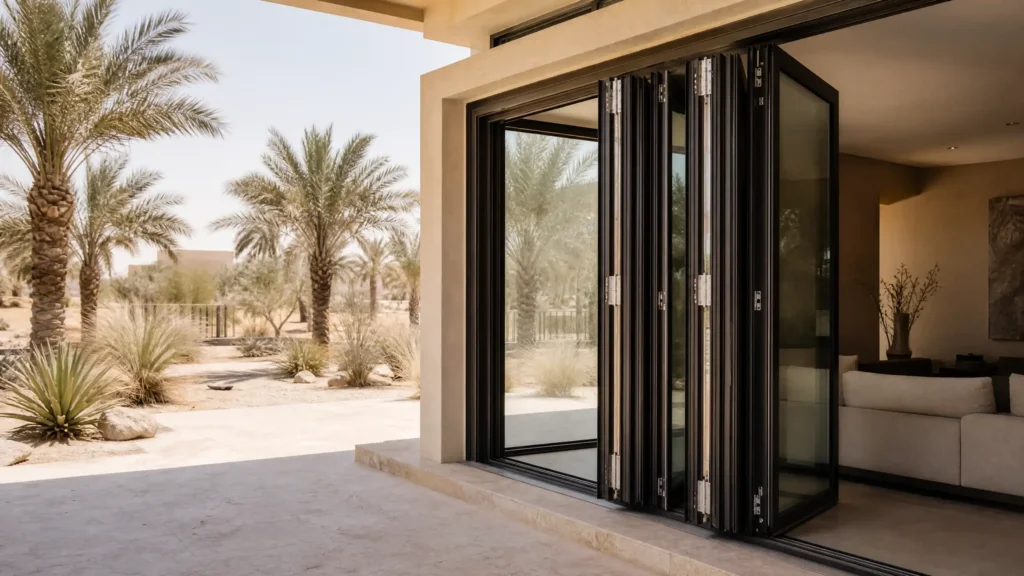
Bi-folding doors are a multi-panel door system where individual glass panels are joined by hinges and fold back against one another, stacking neatly to one or both sides of an opening. Each panel hangs from rollers on a top track while folding at the hinge points, allowing the doors to clear almost the entire width of an opening, a design widely used in Dubai villas to connect living rooms with terraces, gardens, and pool decks.

TL;DR

Bi-folding doors can survive Dubai’s summer climate, provided they are built to local technical specifications. When engineered with thermal-break aluminium tracks, double-glazed Low-E glass, and multi-contact EPDM seals, these systems withstand temperatures exceeding 50°C and severe Shamal sandstorms without warping, leaking AC air, or jamming. Without these specific components, heat transfer and fine dust ingress will degrade the mechanism within two to three seasons.

Table of Contents

The Reality of Dubai's Climate Impact on Glass Doors

Dubai’s summer climate presents two distinct structural threats to exterior door systems: extreme thermal stress and high-velocity particulate abrasion. Between May and September, ambient shade temperatures routinely cross 45°C, while direct sunlight heats exposed exterior aluminium tracks and glass edges up to 70°C. Inside, air conditioning holds room temperatures around 22°C.

This 25°C to 48°C temperature differential across a single door panel creates immense thermal expansion stress. Low-grade glass or poorly engineered frames expand unevenly, leading to misaligned tracks, compromised seals, and potential panel shattering.

Simultaneously, summer Shamal winds drive fine desert sand into every exterior crevice. These micro-particles act like sandpaper on moving parts, stripping away light lubricants and grinding down soft roller bearings if the track mechanism remains exposed.

Bi-Folding Doors vs. Sliding Doors in Extreme Heat

Homeowners comparing options for a Dubai villa often ask whether a sliding door system would handle the climate better than a bi-folding one, since sliding doors have fewer moving joints. The honest answer is that both can perform equally well in extreme heat when correctly specified, the real difference is in what each is optimized for.

Factor

Bi-Folding Doors

Sliding Doors

Seal points

More seal points (one per hinge and panel edge)

Fewer seal points (single running track)

Dust resistance

Compressible EPDM seal at every joint when locked

Fewer joints, but reliant on a single continuous seal

Maximum clear opening

Up to 90% of the opening fully clear

Roughly 50% of the opening clear (with a two-panel slider)

Best suited for

Full wall openings, uninterrupted indoor-outdoor transitions

Narrower openings, spaces prioritizing simplicity

Hinge/hardware complexity

Higher, more moving parts to specify and maintain

Lower, single track and roller set

Ideal application

Villas opening onto a pool deck, garden, or terrace

Balconies, smaller patios, secondary openings

For villas prioritizing an uninterrupted transition to a pool deck, garden, or terrace, bi-folding doors remain the preferred choice despite the added engineering complexity, provided the hinges, hardware, and seals are UAE-climate rated.


How Bi-Folding Doors Handle Severe Thermal Expansion

Standard glass door systems fail in hot desert climates because the frame materials expand at different rates than the glass itself. Premium bi-folding door systems manage this using thick, structural tempered glass panels suspended from reinforced head and floor tracks, with hinge points engineered to absorb movement between panels.

Compared to bulky standard aluminium options which carry a high risk of frame warping and use 70mm to 120mm profiles and high-grade bi-folding doors use ultra-slim 20mm to 45mm profiles where thermal expansion risk is kept low by EPDM seals at every hinge and edge. This allows well-engineered bi-folding doors to reach an average lifespan of 15 to 20 years in UAE conditions, outlasting standard framed doors by up to five years.

Aluminium tracks experience linear thermal expansion of approximately 1.2 mm per meter when temperatures rise by 50°C. High-grade systems incorporate flexible expansion gaps and polyamide thermal breaks within the top and bottom rails. These thermal barriers stop outdoor heat from transferring through the metal track into your interior flooring, preserving both your AC efficiency and the door’s alignment.

Preventing Fine Sand and Dust Ingress During a Shamal

A common concern for villa owners in Palm Jumeirah, Arabian Ranches, and Emirates Hills is fine sand settling inside the living room after a heavy sandstorm. Bi-folding doors solve this using interlocking tongue-and-groove glass edges at every panel joint, fitted with transparent, UV-resistant EPDM rubber gaskets instead of traditional brush seals.

Protection begins at the primary outer seal, which blocks heavy sand and wind pressure. From there, a raised internal barrier redirects micro-dust particles away from the interior, leading to the final internal EPDM gasket that creates an airtight compression barrier.

Unlike woven brush seals, which trap sand and degrade under intense UV radiation, EPDM gaskets compress tightly at every hinge and panel edge when the doors lock into place. This forms an airtight seal rated to international standards (Wind Class 3 and Water Class 8A equivalent).

For ultimate dust protection, specify an elevated flush threshold with built-in drainage channels. This structural lip prevents wind-driven sand from crawling under the bottom track while allowing any trapped rainwater from winter storms to drain outward automatically.

Glass Specifications Required for UAE Sun Exposure

Installing basic single-pane tempered glass in Dubai is a costly mistake. Uncoated single tempered glass has a high Solar Heat Gain Coefficient of 0.82 and blocks less than 25% of UV rays, providing zero impact on cooling efficiency. Uncoated glass absorbs solar radiation, radiating heat directly into your home and forcing your air conditioning system to work continuously.

To ensure durability and heat reflection, your bi-folding door system must use high-performance glass configurations:

  • Double-Glazed Toughened Glass: Two panes of 6mm or 8mm safety glass separated by a 12mm argon gas-filled gap to block conductive heat transfer. This reduces solar heat gain down to 0.60 and cuts AC energy usage by up to 15%.
  • Low-Emissivity (Low-E) Coating: A microscopically thin metallic layer applied to the inner pane that reflects infrared heat back outside while allowing natural sunlight to pass through. By driving the Solar Heat Gain Coefficient down to 0.28 and blocking over 85% of UV rays, Low-E double glazing delivers energy savings of 25% to 35%.
  • Laminated Safety Options: Essential for high-wind areas like coastal Dubai Marina or open desert plots in Ras Al Khaimah, offering impact protection against windborne debris during sandstorms.

How Much Do Bi-Folding Doors Cost in Dubai?

Door Type

Description & Specifications

Estimated Price Range

Standard Single-Pane Clear System

10mm–12mm clear toughened safety glass with basic aluminium tracks

AED 900 – AED 1,200 per m²

Double-Glazed Low-E System

Double safety glass with argon gas insulation and UV-reflective coating

AED 1,500 – AED 2,200 per m²

Premium European Hardware System

Custom laminated/tinted glass with heavy-duty thermal break tracks and German fittings

AED 2,200 – AED 3,000+ per m²


Essential Maintenance Schedule for UAE Conditions

Desert environments require a consistent care routine to keep heavy glass panels folding effortlessly. Fine desert sand is incredibly abrasive and acts like sandpaper, grinding down unmaintained roller bearings, hinges, and tracks over time if left unchecked.

To protect your investment, follow a structured maintenance schedule tailored to local conditions:

  • Monthly Routine: Vacuum lower track channels using a narrow nozzle to lift blown desert sand, then wipe the glass edge seals with a damp microfibre cloth to remove fine dust build-up.
  • Bi-Annual Routine: Every six months, apply a light coat of heavy-duty dry silicone lubricant directly onto roller bearings and hinges. At the same time, flush the bottom track drainage holes with clear water to ensure they remain free of packed sand.
  • Annual Routine: Schedule a professional hardware realignment and comprehensive seal inspection once a year to address any subtle shifting caused by seasonal heat expansion.

A critical mistake to avoid is using petrol-based lubricants or wet spray products like standard WD-40 on your door tracks and hinges. These wet lubricants leave a sticky oil film that actively attracts airborne dust, turning loose sand into a gritty paste that ruins stainless steel roller bearings and speeds up hardware wear. Stick exclusively to dry silicone-based or PTFE sprays that lubricate without holding onto sand particles.

Frequently asked questions

Do bi-folding doors warp in extreme heat?

No, high-grade bi-folding doors do not warp. Structural tempered glass remains dimensionally stable in temperatures well above 100°C. The top and bottom aluminium guide tracks feature integrated polyamide thermal breaks and thermal expansion gaps to absorb metal expansion without putting stress on the glass panels.

Yes, provided they feature double-glazed Low-E glass and thermal-break aluminium tracks. This combination reflects direct solar heat radiation and prevents cold air leakage, reducing indoor cooling loads and lowering summer DEWA electricity bills by up to 30%.

They rely on vertical multi-point locking systems and flexible EPDM synthetic rubber gaskets along every glass edge and hinge. When closed and locked, the panels compress these seals together, creating a barrier that blocks fine desert sand and wind gusts.

A properly maintained aluminium bi-folding door system lasts between 15 and 20 years in the UAE. System longevity depends on regular track and hinge cleaning, avoiding petroleum lubricants, and ensuring the original installation accounts for thermal movement gaps.

Yes, systems tested for UAE coastal conditions use 8mm to 10mm toughened safety glass paired with heavy-duty stainless steel top and bottom rollers. These configurations withstand heavy wind loads without flexing out of their track channels.

Conclusion

Bi-folding doors are fully capable of surviving Dubai’s tough climate, but long-term performance depends heavily on choosing the correct technical specifications from the start. Standard off-the-shelf glass systems simply cannot withstand the severe combination of 50°C summer heat, high coastal humidity, and fine sandstorms. By insisting on high-performance double-glazed Low-E glass, thermal-break aluminium tracks, and UV-resistant EPDM weather seals at every hinge and panel edge, you protect your villa against frame warping, seal degradation, and costly air conditioning leaks.

Connect With Our Experts Instantly.

Copyright © 2025 Elegant Rooms 

Connect With Our Experts Instantly.