
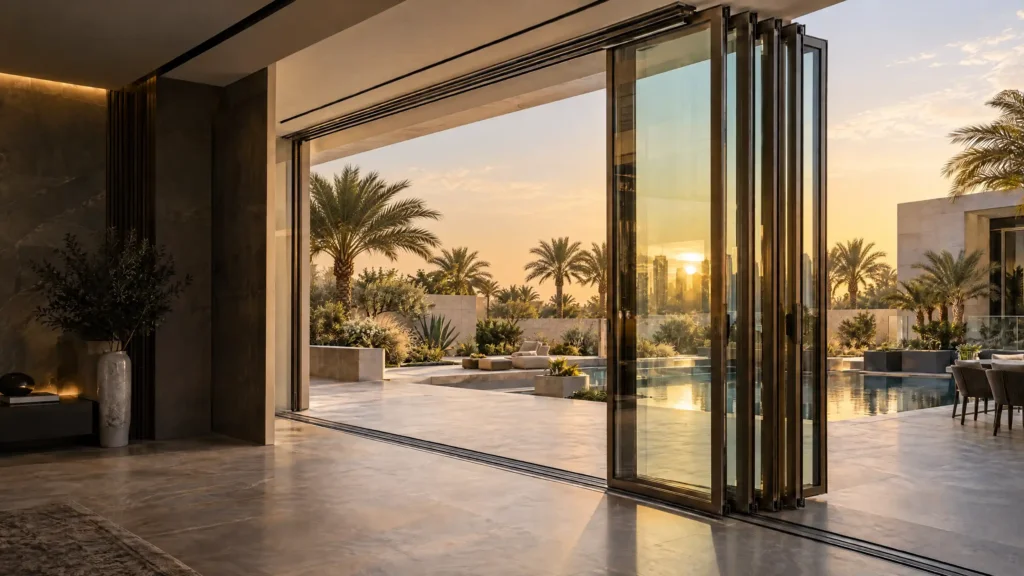
Telescopic sliding doors are multi-panel entrance systems that stack two to four glass leaves behind a single fixed panel, maximizing the clear passage width to 66% of a structural footprint.
If you are deciding on sliding door systems for a Dubai property, standard sliders limit your opening to just 50%. Telescopic doors solve this spatial problem by stacking multiple leaves together, granting a 66% clear passage width within the exact same structural footprint. For the extreme Middle Eastern climate, high-quality telescopic systems do more than save physical space. Automatic motorized variants feature rapid synchronized closing speeds that lock in HVAC cooling and prevent expensive conditioned air loss. When selecting your specific system, you must prioritize brushless DC motors engineered for 50°C+ heat, thermally broken aluminium frames, and tightly sealed roller bearings that resist fine desert sand.
Dubai architecture demands an exact balance between panoramic visual views, spatial efficiency, and extreme environmental climate control. Homeowners in luxury sectors like Palm Jumeirah and Dubai Hills, alongside commercial developers in Downtown Dubai, frequently face narrow entryways. These spaces require maximum natural light and barrier-free access without letting the expensive air conditioning escape into the summer heat.
Standard sliding systems force you into a frustrating compromise, permanently blocking half of your expensive structural opening. Bi-fold systems consume valuable floor space when they fold open, creating dead zones in your living room or patio. Telescopic sliding doors solve this spatial math problem directly.
This guide breaks down exactly how these multi-leaf, stackable systems function in extreme Middle Eastern weather conditions. You will learn the mechanical differences between frameless glass and thermal-break aluminium profiles, how dust-resistant hardware prevents track failure, and why precise sensor selection matters under intense UAE sunlight. By the end of this guide, you will know exactly what specifications to demand from your Dubai installer to protect your property and lower your cooling costs.
A Telescopic Door operates as a multi-panel sliding system where two to four individual glass leaves slide and stack neatly behind a single fixed panel. Unlike standard bifold doors that swing outward on hinges and consume usable floor space, telescopic panels glide parallel to the wall along a multi-track overhead drive.
The primary advantage of this engineering lies in the spatial math. A standard two-pane sliding door provides a maximum clear opening width of only 50%. A three-leaf telescopic door expands that clear passage width up to 66% within the exact same structural footprint. Four-leaf systems push this efficiency even further. When the system initiates an opening sequence, a synchronized gear or belt drive pulls the lead panel. The secondary panels follow at proportional, reduced speeds to arrive at a perfectly even stack simultaneously.
This specific barrier-free access standard makes telescopic models highly effective for tight spaces, narrow villa corridors, and high-volume pedestrian zones in shopping malls. Because the heavy glass panels slide flat against each other, you gain massive clear openings without sacrificing the minimalist, modern aesthetic favored in luxury Dubai properties.
Installing the correct door system in the UAE requires addressing high foot traffic, highly valued real estate footprints, and an aggressively hot desert environment. Telescopic configurations answer these local demands through intelligent structural engineering and climate-adapted mechanics.
Framed partitions hold glass within visible profiles, often aluminium. Frameless partitions minimise visible framing, although they still need supporting channels, fittings and joints.
An aluminium glass partition can suit a clearly defined office grid or a black-framed meeting room. A minimal-frame system can make a narrow reception area feel less enclosed. Neither appearance proves acoustic performance: compare the tested wall construction, not the amount of metal you can see.
Dubai’s extreme summer heat forces air conditioning units to work continuously at high capacities. Every single time an exterior door opens, heavy HVAC energy efficiency penalties occur as cold air spills out.
This operational speed directly reduces your AC load, creating substantial energy savings during peak summer months. By closing quickly and tightly, the system acts as an active thermal barrier.
Selecting the right physical configuration depends entirely on where the door lives and how much direct environmental exposure it faces on a daily basis.
Your frame material choice dictates both the visual impact and thermal performance of the entry system. Aluminium-framed telescopic doors incorporate heavy-duty carriages, double-glazed units, and internal thermal breaks that stop outside heat from transferring into cooled interiors through thermal bridging, while supporting acoustic performance up to 41dB against heavy street noise. Conversely, frameless glass models lack deep weather seals and belong strictly indoors, serving as interior room dividers, corporate meeting room partitions, or climate transitions where ultra-slim sightlines take priority.
Operating mechanisms determine how effortlessly your door handles daily traffic flow. Manual telescopic doors rely on a physical synchronizing gear where pulling the lead handle drags secondary panels along the track in proportion, offering simple mechanical reliability for low-traffic residential exits. Automatic motorized doors represent the modern standard for high-volume pedestrian zones, hotels, and smart villas, relying on overhead motion sensors and high-capacity brushless DC motors to manage heavy glass spans for hygienic, touch-free access.
To prevent mechanical failures, thermal expansion and binding, and voided warranties, your procurement checklist must address the specific environmental threats of the Middle East.
Standard European or Asian door motors often fail quickly in the UAE because they cannot vent internal heat fast enough in the summer. Demand brushless DC motors rated for continuous operation in temperatures exceeding 50°C. Brushless designs eliminate physical friction inside the motor, dramatically extending the lifespan of the drive system when operating inside a hot, enclosed overhead transom.
Desert sand destroys sliding door tracks rapidly. Fine silica dust grinds into the floor guides and jams standard rollers, leading to expensive breakdowns.
Extreme temperature differentials cause severe material stress. When the outside glass face hits 60°C in direct sun while the inside face sits at 22°C, standard glass can shatter from thermal shock. Always specify toughened safety glass or laminated safety glass. For exterior doors facing direct sunlight, combine this safety glass with low-emissivity (Low-E) coatings to reflect UV rays and drastically reduce solar heat gain inside the property.
Modern automatic telescopic sliding doors must communicate directly with your existing property infrastructure. Check that the control board accepts standard inputs for biometric scanners, RFID card readers, or smart home platforms like KNX. Furthermore, intense UAE sunlight frequently causes sensor glare, confusing cheap infrared motion sensors into staying open permanently. Require high-quality, dual-technology sensors calibrated specifically for bright, highly reflective environments.
Even the highest-rated hardware requires periodic calibration, belt tensioning, and track cleaning. Avoid importing obscure brands with no local UAE footprint. Work exclusively with local suppliers who stock spare drive belts, heavy-duty carriages, and control boards physically within Dubai or Sharjah. Demand a guaranteed service-level agreement for rapid, on-site repairs to prevent your property from remaining unsecured during a breakdown.
Standard sliding doors yield a 50% clear opening, whereas multi-panel telescopic doors stack together on a multi-track system to provide up to a 66% clear passage in the exact same footprint.
Yes, as long as they are fitted with thermally broken aluminium frames, high-temperature brushless DC motors, and sealed roller bearings with dense brush seals.
Basic manual frameless systems start around 1,000 to 1,500 AED per square meter, whereas fully motorized exterior automatic installations typically range between 12,000 and 25,000 AED.
Telescopic doors are better for narrow spaces because they slide flat in-line without consuming floor swing space or creating dead zones like bifold doors.
Their multi-track sills collect more desert dust and require regular vacuuming to prevent friction, though internal sealed bearings protect the drive motor from damage.
Yes, frameless glass panels can mount directly to an overhead automatic multi-track drive to deliver touch-free motorized operation with clear sightlines.
Selecting the right telescopic door in Dubai requires looking past the initial visual appeal and focusing heavily on regional mechanical engineering. By moving away from standard 50% sliders, you open up your property, improve daily traffic flow, and create a sophisticated, barrier-free environment. Prioritize thermal-break frames, sand-resistant track hardware, and high-heat brushless motors to protect your financial investment against the harsh Middle Eastern climate. If you are ready to upgrade your spatial layout and maximize your structural opening, contact a specialized UAE entrance automation company today to book a free site measurement and technical consultation.