
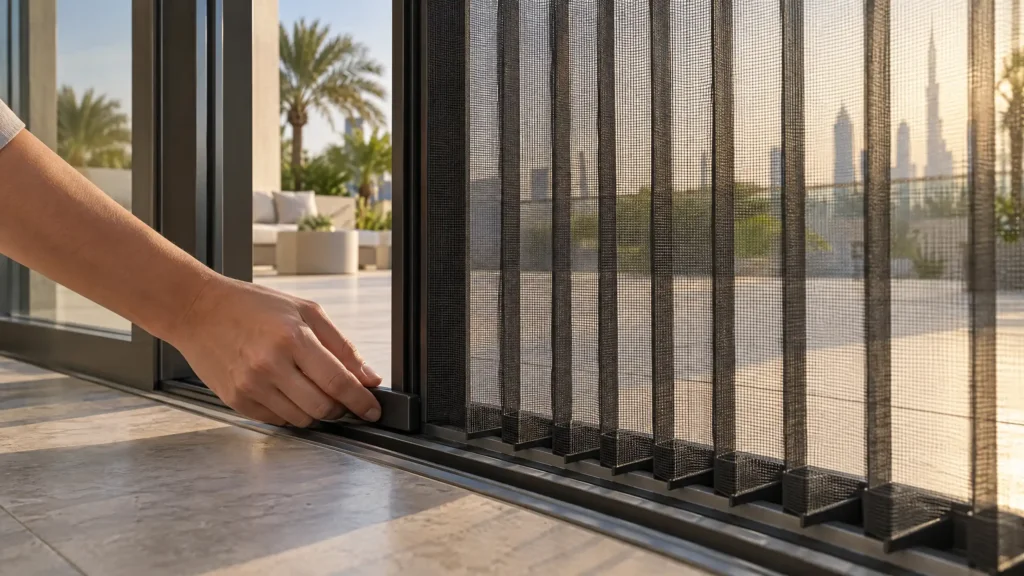
A pleated mesh screen is a retractable insect barrier made of accordion-folded polyester or fiberglass weave set within a powder-coated aluminium frame, designed to block pests and dust while withstanding extreme Gulf temperatures without relying on fragile spring-loaded rollers.
Yes, pleated mesh screens are the best choice for Dubai weather because they do not use the internal tension springs that commonly snap or jam in sand and 50°C summer heat. By folding like an accordion into a protective, powder-coated aluminium frame, high-grade Italian polyester mesh avoids constant UV degradation, handles wide villa patio spans up to 6 metres, and allows homeowners to enjoy natural winter ventilation without insects or high maintenance costs.
Stepping out onto your balcony in Dubai Marina or opening the patio doors of your Arabian Ranches villa during November should be a relief. After five months of sealing the house shut against 48°C summer temperatures, every UAE resident wants fresh air. Instead, you pull across your existing fly screen, hear a loud metallic snap, and watch the mesh jam halfway down the track.
Pleated mesh screens are the most durable and practical insect screening solution for Dubai properties because their spring-free accordion design resists heat damage, sand blockages, and high coastal winds. Unlike traditional flat screens, a pleated system folds back into a side cassette when not in use, shielding the fabric from constant solar radiation.
To understand why this specific design works in the Gulf, we have to look at the three environmental stressors that destroy exterior home fixtures in the UAE. From May to September, ambient temperatures regularly exceed 45°C, while direct surface temperatures on dark metal window frames hit 70°C. Combine this thermal expansion with 80 percent coastal humidity in areas like Jumeirah and Palm Jumeirah, plus the abrasive fine sand carried by shamal winds, and you have a hostile environment for moving parts.
Standard roll-up fly screens fail in the UAE summer because their internal metal torsion springs lose tension under extreme thermal expansion, and fine desert dust clogs the narrow roller barrels. Once sand enters the sealed spring mechanism, the screen either refuses to retract or snaps violently, tearing the flat fiberglass sheet.
A roll-up screen — often called a roller screen — works just like a traditional window roller blind. A flat sheet of fiberglass mesh wraps around a central aluminium tube containing a tightly wound steel spring. Every time you pull the screen across your window or door, you increase the torque on that spring. In mild climates, this mechanism lasts five to seven years. In Dubai, Abu Dhabi, or Sharjah, the lifespan often drops to less than 18 months.
Pleated mesh survives 50°C heat and intense UV exposure by using a stiffened, thermoset Italian polyester weave or PVC-coated fiberglass that maintains its structural memory without sagging or melting. This specialized fabric is paired with architectural-grade, powder-coated aluminium frames that resist salt air corrosion and thermal warping.
Material selection separates a five-year investment from a one-season frustration. In the UAE market, top-tier suppliers use a 1.8mm by 1.8mm weave made from water-repellent polyester. During manufacturing, this polyester undergoes a heat-setting process where the crisp 15mm to 20mm accordion folds are baked into the fabric at temperatures exceeding 180°C. Because the curing temperature is more than double the hottest surface temperature in a Dubai summer, the pleats never flatten out or sag under the sun.
Screen Style | Best Application & Max Span | Key Operational Features | UAE Weather & Usage Limitations | Expected Lifespan |
Pleated Retractable Screens | Wide sliding patio doors & bi-fold glass walls (Up to 3m single sash; 6m double-meeting sash). | 3mm–5mm low-profile bottom track (wheelchair, stroller, and barefoot friendly). Stops at any position along the track without snapping back. | Requires occasional water rinsing and track vacuuming to clear settled desert dust. | 7 to 10 years |
Spring Roll-Up Screens | Small, high bathroom or kitchen casement windows (Under 1.2m wide where hand reach is limited). | Coils into a spring-loaded barrel and requires a locking latch at the end post to stay closed. | High spring tension makes the handle slam back into the housing if released accidentally, damaging the frame on full-height doors. | 1 to 2 years (on doors) |
Magnetic Stick-On Curtains | Short-term temporary fix for rental apartments (50 to 150 AED). | Attaches to uPVC or aluminium frames via adhesive Velcro strips with weighted bottom hems. | Adhesive melts off within 3 weeks of June heat, leaving sticky chemical residue; bottom weights drag in sand and leave gaps for mosquitoes. | Under 1 summer |
Hinged Aluminium Mesh Doors | Back service kitchens or maid’s room exits. | Rigid swinging door built with a heavy central kickplate and pneumatic closer. | Requires a full 90-degree clearance arc to swing, blocking patio furniture and permanently obstructing modern glass aesthetics. | 5 to 8 years |
Installing pleated fly screens can lower your DEWA or ADDC electricity bills by 15 percent to 25 percent during the transitional months of October, November, March, and April by replacing mechanical air conditioning with natural cross-ventilation. By opening opposite windows and patio doors without letting pests inside, you cool your home’s thermal mass for free.
Air conditioning accounts for roughly 60 percent to 70 percent of a typical UAE household’s annual electricity consumption. While nobody turns off their AC in July or August, millions of dirhams are wasted across Dubai every autumn and spring. During October and April, daytime highs sit around 30°C while nighttime temperatures drop to a pleasant 21°C. Many residents keep their sliding glass doors locked and their AC thermostats set to 22°C during these months simply because opening the doors invites mosquitoes, houseflies, and nocturnal moths inside.
Before ordering custom pleated screens in the UAE, verify that the supplier uses replaceable mesh cartridges, 3mm wheel-friendly bottom tracks, and concealed installation clips that require minimal drilling into your thermal-break window frames. Always ask for a physical sample of both the aluminium profile and the mesh weave during the home survey.
Not all pleated screens sold in the UAE are manufactured to the same engineering standard. Some workshops import thin, low-grade kits that use brittle nylon cords and rough plastic sliders that squeak after a single sandstorm. When a technical surveyor visits your home for measurements, evaluate their product against three specific structural benchmarks:
To clean pleated screens after a Dubai sandstorm, vacuum the bottom guide track with a soft brush attachment to remove loose grit, then wipe the folded mesh gently with a damp microfibre cloth and mild soapy water. Never spray the tension cords with petroleum-based lubricants like WD-40, as oil attracts desert dust and forms a grinding paste.
Maintenance is the primary variable that determines whether your screen lasts three years or ten years. In the UAE, fine calcium carbonate dust settles inside the bottom channel every week. If you repeatedly force the sliding bar over pebbles or caked sand, you will eventually fray the bottom Kevlar guide cord that keeps the screen upright and balanced.
Yes, modular pleated screen systems allow technicians to unclip the inner cartridge and replace torn mesh and tension cords in under 45 minutes for roughly 30 percent to 40 percent of the original unit cost without disturbing your painted walls or outer aluminium frame.
No, high-grade 1.8mm charcoal or grey polyester pleated mesh allows over 80 percent of natural daylight and airflow into your room while absorbing solar glare, giving you a clear, sharp view of your garden or balcony.
Pleated polyester mesh resists light bumping better than flat fiberglass because the accordion folds absorb impact and remain clearly visible to animals, though heavy dog claws can still puncture the weave and may require a heavy-duty pet-mesh upgrade on the lower half.
Most established UAE suppliers complete the laser measurement survey within 24 hours of booking and manufacture custom-sized frames in 3 to 5 working days, unless you request a bespoke RAL powder-coat colour which extends production to 7 to 10 working days.
Yes, multi-panel pleated systems use connectable interlocking tracks to span continuous openings up to 6 metres wide without requiring any permanent vertical support posts in the middle of your doorway.
No, pleated screens run on continuous top and bottom Kevlar tension cords threaded directly through the fabric folds, preventing the mesh from billowing out of its frame even in breezy high-rise buildings up to the 40th floor.
Waiting until the first cool week of November to order insect screens puts you right in the middle of the UAE’s peak installation rush, when lead times double and mosquito populations spike across residential communities. Pleated mesh screens solve the mechanical weaknesses of traditional roll-up models by eliminating fragile internal springs, tucking heat-resistant polyester fabric safely away from the summer sun, and handling the wide glass spans of modern Emirates properties.