
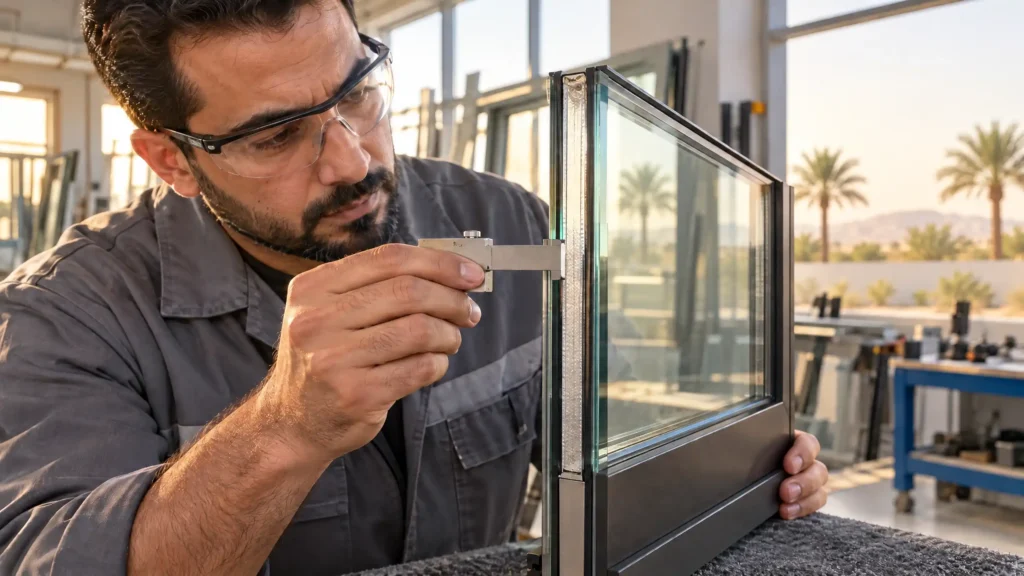
Double glazed glass thickness and air gap ratios refer to the exact millimetre measurements of two glass panes and the sealed gas-filled cavity between them inside an Insulated Glass Unit (IGU),typically starting at a 24mm total profile (4mm outer glass, 16mm air gap, and 4mm inner glass) to block heat transfer and outside noise.
If you are replacing villa windows in Dubai or specifying facade glass in Abu Dhabi, never accept a generic 24mm unit without checking the individual pane ratios. For standard residential windows away from main roads, specify a 28mm unit with a 6mm solar-control Low-E outer pane, a 16mm Argon-filled air gap, and a 6mm clear inner pane. Never allow an air gap wider than 16mm to 18mm because wider cavities create internal air loops that ruin heat insulation. If your property faces Sheikh Zayed Road, construction sites, or flight paths, switch to an asymmetric ratio where the outer pane is at least 30% thicker than the inner pane—such as an 8.38mm acoustic laminated outer pane, a 14mm air gap, and a 6mm inner pane—to stop sound waves from vibrating through both sheets of glass at the same frequency.
An Insulated Glass Unit (IGU)—commonly called a Double Glazed Unit (DGU)—is a factory-sealed combination of two glass panes separated by a hollow spacer bar that traps a dehydrated air or gas cavity. Glazing engineers write this ratio as three numbers in millimetres: Outer Pane – Air Gap – Inner Pane. For example, a standard 24mm unit carries the code 4-16-4, meaning a 4mm outside glass sheet, a 16mm sealed cavity, and a 4mm inside glass sheet.
Each part of that three-number ratio performs a specific job in the UAE climate. The outer pane faces the street and takes the brunt of wind pressure, flying sand, and direct sunlight. The middle air gap acts as a thermal brake that slows down heat conduction from the hot exterior glass to the cool interior glass. The inner pane seals the room and holds back low-frequency noise that manages to cross the gap.
Standard residential double glazing in the UAE requires a minimum glass pane thickness of 6mm per sheet for villa sliding doors and 8mm to 10mm for large floor-to-ceiling windows or high-rise apartments. While 4mm glass works for small bathroom or kitchen windows under 1.2 square metres, large glass spans made with 4mm panes flex under coastal winds and vibrate violently when heavy trucks drive past.
Choosing the exact millimetre thickness depends on three mechanical limits: panel size, wind load, and safety regulations set by Dubai Municipality and Abu Dhabi Department of Municipalities and Transport. If a single window sash covers more than 2.5 square metres, using 4mm glass causes visible bowing that presses the panes inward toward the air gap. That inward flex heats up the trapped gas and can crack the glass right down the centre.
The optimal air gap width for thermal insulation in double glazed windows is between 12mm and 16mm because cavities narrower than 10mm allow heat to jump straight across, while cavities wider than 18mm trigger internal heat-carrying air loops. Many homeowners mistakenly ask fabricators for a massive 20mm or 24mm air gap inside a thick frame, believing that a wider gap equals a cooler home.
Building physics proves the opposite. Heat travels across a sealed window gap through conduction (molecules bumping into each other) and convection (warm air rising and cool air sinking in a circle). When the air gap sits at 6mm or 8mm, the two glass panes sit too close together, allowing heat from the sun-baked outer pane to conduct directly through the gas into your air-conditioned room.
Pumping Argon gas into a 16mm air gap instead of standard dehydrated air improves thermal insulation by roughly 10% to 15% because Argon is denser and moves slower than oxygen and nitrogen. Because Argon atoms are heavier, they sluggishly resist the convection currents caused by extreme desert temperatures, helping your window hit strict green building targets.
An asymmetric glass ratio stops outdoor noise by pairing two glass panes of different thicknesses—such as an 8mm outer pane and a 5mm or 6mm inner pane—so each sheet blocks a different sound frequency. Standard symmetrical double glazing like a 6-16-6 unit fails miserably against highway traffic, sirens, and night-time construction because both 6mm panes share the exact same natural resonant frequency.
In acoustic engineering, this failure is called the coincidence dip. When a low-frequency sound wave from a roaring sports car hits a 6mm outer pane, the glass vibrates at a specific pitch. Because the inner pane is also 6mm thick, it tunes into that exact same vibration across the air gap and amplifies the noise straight into your room, making it sound as if the window is slightly open.
Installing pleated fly screens can lower your DEWA or ADDC electricity bills by 15 percent to 25 percent during the transitional months of October, November, March, and April by replacing mechanical air conditioning with natural cross-ventilation. By opening opposite windows and patio doors without letting pests inside, you cool your home’s thermal mass for free.
Air conditioning accounts for roughly 60 percent to 70 percent of a typical UAE household’s annual electricity consumption. While nobody turns off their AC in July or August, millions of dirhams are wasted across Dubai every autumn and spring. During October and April, daytime highs sit around 30°C while nighttime temperatures drop to a pleasant 21°C. Many residents keep their sliding glass doors locked and their AC thermostats set to 22°C during these months simply because opening the doors invites mosquitoes, houseflies, and nocturnal moths inside.
Hardware / Frame Factor | Standard / Economical Spec | Heavy-Duty / Acoustic Spec | Mechanical Limit & Failure Risk | Required Upgrade / Solution |
Glass Unit Weight (2.5 kg/m² per 1mm of glass) | 4-16-4 Unit (8mm total glass) = 20 kg/m² (60 kg for a 3m² door leaf) | 8-14-6 Unit (14mm total glass) = 35 kg/m² (105 kg for a 3m² door leaf) | Standard friction hinges snap and cheap rollers get crushed if the profile is not built for the load. | Calculate exact sash weight before ordering 8mm or 10mm glass panels. |
Frame Rebate Depth (Glazing Pocket) | Caps out at a 24mm glazing pocket on economical non-thermal aluminium series. | Accommodates 28mm to 44mm units on premium thermal-break systems. | Thick double glazed units physically cannot fit into shallow standard profiles. | Specify premium thermal-break profiles (such as Alumil, Schüco, or Technal) or compatible uPVC systems. |
Roller & Hinge Capacity | Standard single-wheel nylon rollers (designed for light loads). | Heavy-duty hardware required for 6mm+ double glazing exceeding 90 kg per sash. | Nylon rollers flatten under 105 kg within weeks, causing sliding doors to drag and jam on the track. | Upgrade to stainless steel tandem bogie (double or quad-wheel) rollers rated for 150 kg to 300 kg per sash. |
Perimeter Edge Seal (Spacer Bar) | Standard hollow aluminium spacer bars inside the air gap. | Composite or stainless steel warm-edge spacer bars. | Hollow aluminium conducts desert heat straight through the edge of the glass where it meets the frame. | Swap standard aluminium spacers for warm-edge spacer bars to block perimeter heat transfer. |
Matching your glass thickness and air gap ratio to the specific direction and noise level of each wall saves you from overspending on quiet courtyard windows while giving your exposed bedrooms maximum protection. Use these four field-tested combinations when requesting quotes from UAE glazing contractors:
A 16mm air or Argon-filled cavity is the best air gap for the UAE because it delivers maximum heat insulation without triggering the internal air circulation loops that ruin cavities wider than 18mm.
A 28mm unit (6-16-6) outperforms a 24mm unit (4-16-4) for UAE villas because the thicker 6mm glass panes resist high wind loads on large doors while retaining the optimal 16mm thermal air gap.
No, widening a window air gap from 12mm to 20mm barely changes noise levels; stopping traffic noise requires using asymmetric glass pane thicknesses (like 8mm and 6mm) or adding an acoustic laminated interlayer.
Double glazed glass weighs 2.5 kilograms per square metre for every 1mm of combined glass thickness, meaning a 4-16-4 unit (8mm glass) weighs 20kg/m2 and a 6-16-6 unit (12mm glass) weighs 30kg/m2.
Moisture or fog appears inside the air gap when extreme desert heat degrades the outer rubber perimeter seal, allowing humid outdoor air to leak in and saturate the drying desiccant beads inside the spacer bar.
In hot climates like the UAE, the Solar Control Low-E coating must sit on Surface 2 (the inside face of the exterior glass pane) so it reflects solar heat away before it crosses the air gap.
You cannot fit a 28mm glass unit into a frame built for 24mm glass unless the aluminium manufacturer supplies a slimmer snap-in glazing bead designed to widen the frame’s internal rebate pocket.
Never let a window contractor hand you a quotation that simply states “24mm Double Glazed Glass” without breaking down the exact pane thicknesses, spacer width, coating position, and glass treatments. Before you pay a deposit on your next renovation or build, pull out your floor plan and mark which walls face direct afternoon sun and which rooms face busy roads. Send your fabricator the exact three-number ratio—such as 6-16-6 with Surface 2 Low-E for quiet rooms and 8.38-14-6 acoustic laminated for noisy bedrooms—and ask them to verify in writing that their thermal-break frames and rollers can support the exact kilogram weight of your glass.