
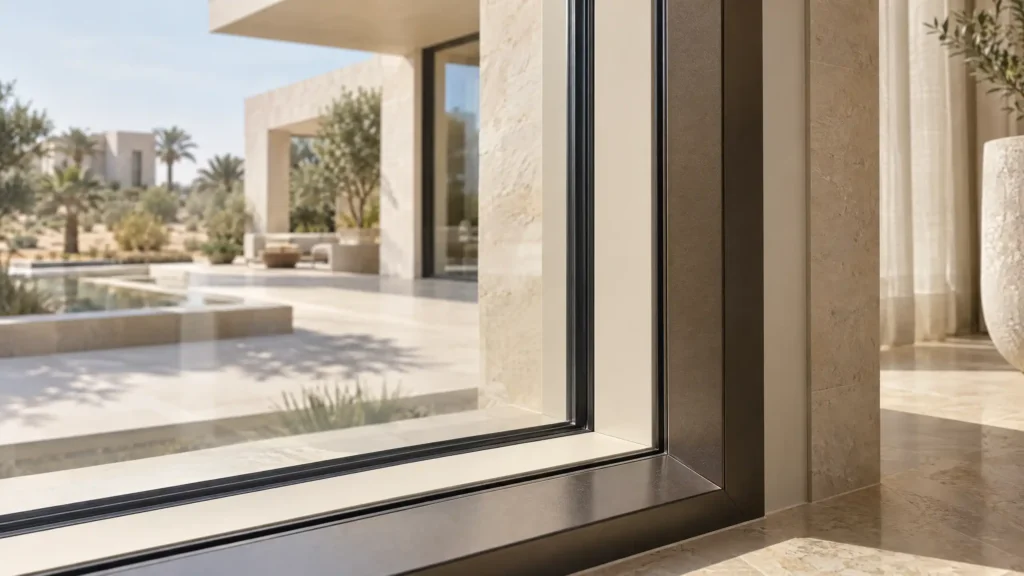
Dual color aluminum is an architectural fenestration system made of two distinct aluminum extrusions joined by a polyamide thermal break bar, allowing one color finish on the exterior face and a completely different color or finish on the interior face of a single window or door profile.
Dual color aluminum allows you to have one finish on the exterior of your doors and windows to match community rules, and an entirely different finish on the inside to match your interior design. It works by finishing two separate aluminum profiles through powder coating or anodising before mechanically crimping them together using a structural polyamide thermal break bar. This setup stops thermal transfer, protects against high desert sun exposure, and prevents costly repainting failures. Dual color systems typically cost 15% to 25% more than single-color frames and add 2 to 3 weeks to fabrication timelines, but they solve building management code restrictions without forcing you to sacrifice interior styling.
Building or renovating a villa in Dubai, Abu Dhabi, or Sharjah often comes with an immediate design roadblock. Your master developer or community management enforces strict exterior facade rules, usually demanding neutral shades like desert sand, bronze, or anthracite grey. Inside, however, your interior design palette calls for warm wood-effect textures, crisp matte white, or soft beige.
Dual color aluminum, also called two-tone or bicolour aluminum, is a window and door frame system that features one specific color or texture on the exterior surface and a completely different color or texture on the interior surface.
Unlike basic aluminum profiles coated in a single shade across the entire section, dual color systems use two independent aluminum extrusions. These extrusions are treated, coated, and cured separately before being permanently assembled into a single, cohesive architectural profile.
This engineering approach gives property owners complete design freedom on their interior walls while keeping the building’s exterior 100% compliant with local developer guidelines. It also means you never have to settle for a generic commercial look inside your living areas.
Dual color aluminum works by splitting the frame into two separate outer and inner sections, applying dedicated finishes to each section on an industrial coating line, and joining them together using a high-density polyamide insulating bar.
The entire process relies on five manufacturing stages:
Because the two aluminum sections never make direct metal-to-metal contact, the profile also acts as a thermal break. The polyamide core blocks heat from conduction through the metal, helping air conditioners maintain lower indoor temperatures during peak summer months.
Operating a home in the Emirates presents two distinct challenges: rigid community design covenants and severe outdoor heat. Dual color aluminum addresses both factors directly through targeted architectural engineering.
First, major developments across Dubai Hills, Palm Jumeirah, and Saadiyat Island require uniform exterior facades. If a homeowner installs bright white window frames facing the street in a neighborhood zoned for charcoal grey, the community association can issue hefty fines or block building completion certificates. Dual color frames meet exterior covenants on the outside
Dual color profiles are finished using two primary industrial methods: electrostatic powder coating and anodising. Both methods deliver distinct visual attributes, operational lifespans, and maintenance needs.
Powder coating is the most popular choice for residential villas. In this method, electrically charged dry paint pigment is sprayed onto grounded aluminum profiles before the metal enters a curing oven at 180°C to 200°C. The heat melts the powder into a hard, continuous protective skin.
For properties in the Middle East, fabricators use Qualicoat Class 2 super-durable powders. These formulations withstand high levels of UV radiation and resist airborne salt and sand abrasion far better than standard Class 1 coatings. Powder coating gives you access to the entire international RAL color register, from deep architectural bronzes to pale pastel undertones, as well as textured stone and timber sublimation finishes.
Anodising is an electrochemical treatment that transforms the aluminum surface into an integrated, corrosion-proof aluminum oxide layer. Because the protective layer forms from the metal itself rather than sitting on top as a film, it cannot peel, flake, or blister.
The process involves submerging the cleaned aluminum into a sulfuric acid electrolyte bath and running an electrical current through the tank. The resulting porous oxide layer absorbs organic or inorganic metal dyes before being sealed in boiling demineralised water. Anodising creates rich metallic finishes—such as champagne, deep bronze, natural silver, and black—that highlight the raw sheen of the metal while resisting scratching.
Homeowners often ask if they can change their interior frame color by painting their existing single-color aluminum windows with a brush, roller, or hand sprayer. The simple answer is no; site painting invariably fails within 12 to 24 months under local conditions.
If you attempt to paint frames after installation, you also risk coating over the rubber perimeter seals, weep drainage holes, and moving hardware. That leads to water leaks during winter rainstorms and drafts during dust storms. If you want two distinct colors, you must order factory-assembled dual color profiles from the start.
Dual color aluminum costs more and takes longer to manufacture than standard single-color profiles. Knowing the precise numbers and production differences helps you budget your renovation accurately.
Lead times are similarly extended. While standard single-color extrusions ship within 3 to 4 weeks, dual color orders generally take 5 to 7 weeks from technical approval to site delivery. Plan your project schedule around this 2-to-3-week buffer to avoid delaying glazing and civil handover milestones.
Specifying dual color fenestration requires careful planning around visibility, opening geometry, and material transitions. Avoid these three common design mistakes:
When a casement window or terrace door swings open, the inner edge of the sash profile becomes visible from both sides. Work with your fabricator to place the color transition line behind the rubber compression gasket so that the interior shade is completely hidden when the door is closed.
Choosing a black handle for an interior white profile can work as an intentional accent, but mismatched hinge bodies and drainage caps often look accidental. Specify all visible hardware finishes on your architectural drawings before production begins.
If your interior frame color is warm ivory, make sure your perimeter skirting, stone sills, and architraves match that exact undertone. An ivory aluminum frame placed against cool, blue-tinted marble sills creates an awkward clash that draws the eye for the wrong reasons.
When evaluating dual color options, homeowners often compare them to composite aluminum-clad timber or vinyl (uPVC) frames. Here is how they stack up across key performance metrics:
Performance Metric | Dual Color Aluminum (Thermal Break) | Aluminum-Clad Timber | Dual Color uPVC |
Heat & UV Resistance | Exceptional; does not degrade under high heat | High; external metal shields wood interior | Moderate; can expand or warp in extreme heat |
Structural Sightlines | Slim profiles with high glass-to-frame ratios | Bulky sections required for timber strength | Thicker sections needed to avoid sash sagging |
Internal Maintenance | Zero maintenance; wipe down with water | Needs routine sealing to stop humidity rot | Low; prone to static dust buildup |
Average Cost Profile | Moderate to High | High to Very High | Low to Moderate |
Design Options | Unlimited RAL powder and wood-grain prints | Natural wood species and interior stains | Limited foil wrap options |
Dual color aluminum delivers the best balance of structural strength, narrow sightlines, and zero-maintenance durability for regional conditions.
Dual color aluminum is a thermally broken frame engineered with two separate extrusions, providing one color on the exterior face and an entirely different color on the interior face.
Inner and outer aluminum profiles are coated separately, joined with a polyamide thermal bar, and crimped together with rolling machines to form a single rigid frame.
No, factory finishes require electrostatic powder baking, meaning field-applied brush or spray paints peel and chalk quickly in hot climates.
Yes, the structural polyamide strip joining the two metal profiles breaks heat conduction, cutting cooling losses and lowering electricity demands.
They require two separate trips through the coating line, additional protective handling, and dedicated mechanical crimping to combine the inner and outer extrusions.
Qualicoat Class 2 architectural powder coats are formulated for high-UV environments to stop chalking, cracking, and fading over decades of exposure.
Yes, you can specify a textured, weather-resistant powder coat on the outdoor profile and a smooth, easy-clean finish on the indoor profile.
Dual color aluminum resolves the tension between exterior building codes and interior design choices, making it an ideal glazing choice for villas, penthouses, and commercial properties.
If you are planning a renovation or new build, start by requesting your community’s official design code to pinpoint your required exterior RAL color. Next, sit down with your interior designer to lock in your indoor finishes and hardware accents.
Finally, require your fabricator to submit physical, corner-cut profile samples showing the crimped polyamide break. Testing the color split, rubber gasket placement, and finish quality in your own hands before signing off on manufacturing protects your investment and delivers the exact look your property deserves.