
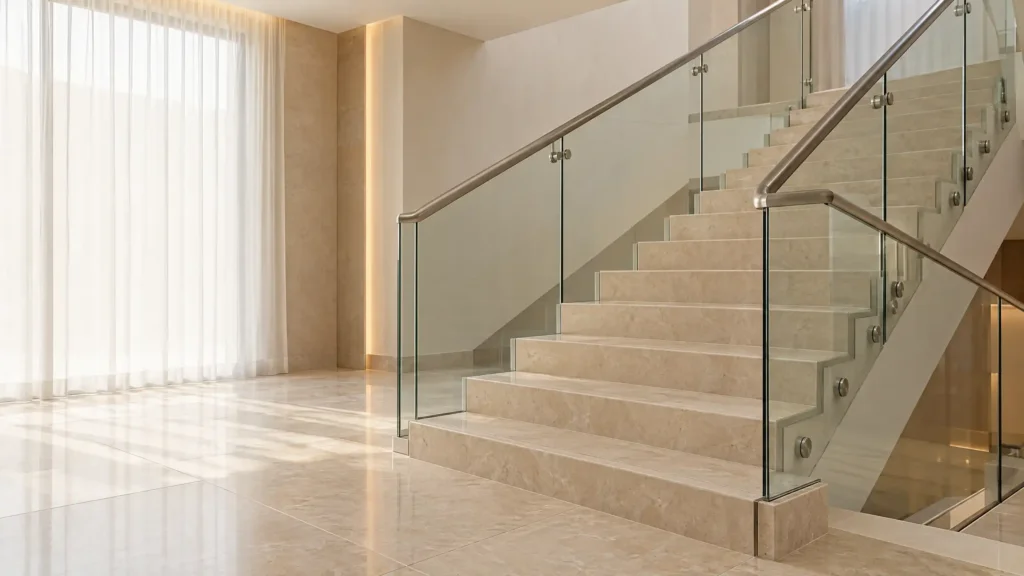
Glass staircase railings are structural safety barriers made from thick tempered or laminated glass panels, designed to prevent falls while offering clear sightlines in residential properties.
Glass staircase railings provide exceptional safety for families with children and pets when installed to UAE building codes. Because they feature solid panels without vertical gaps or horizontal bars, they completely remove the risks of toddlers climbing and small pets falling through. By selecting laminated safety glass with a minimum thickness of 12mm to 17.5mm, paired with marine-grade stainless steel hardware, homeowners get a barrier that withstands high impacts without shattering.
When UAE homeowners renovate villas in communities like Dubai Hills or Arabian Ranches, the staircase often becomes a central design feature. Modern architecture favors light, open spaces, making transparent barriers a highly popular choice. However, parents and pet owners immediately face a highly specific anxiety before approving these designs. They picture a heavy toy thrown against a glass panel, a toddler tripping on the stairs, or a large dog crashing into a clear barrier.
These fears make sense, but they often stem from a misunderstanding of how structural architectural materials actually function. The material used in residential staircases shares almost no physical properties with the fragile material found in drinking glasses or standard windows. Modern glass balustrades undergo intense thermal and chemical treatments to turn them into heavy-duty structural barriers.
Glass railings offer superior protection for toddlers because they eliminate the physical shapes that cause staircase accidents. Traditional railings rely on a series of vertical posts called balusters. These posts must sit close enough together to prevent a child from slipping through, but they still present significant hazards.
The most common danger with traditional staircases is the “ladder effect.” If a metal or wooden railing includes any horizontal support bars, a toddler will instinctively use them as steps to climb up and look over the top edge. A solid, transparent panel provides a completely smooth, flush surface. It gives toddlers absolutely zero footholds, making it physically impossible for a child to scale the barrier.
Head entrapment represents another serious risk with older staircase designs. If the gaps between wooden spindles exceed four inches, a curious child can easily wedge their head between the posts. Solid panels completely remove these gaps. The barrier runs continuously from the floor track to the top handrail, leaving no open spaces for a child to explore.
Small pets face distinct dangers around traditional staircases, particularly in open-tread or high-ceiling duplex designs. Puppies and small cat breeds can easily slip through standard wrought iron balusters. If a dog becomes startled or excited by activity on the ground floor, they might try to push through the railing to get a better view, resulting in a dangerous fall from the upper landing.
Solid transparent panels block this completely. The pet gets full visibility of the lower floor without any physical opening to squeeze through. However, animals process visual information differently than humans do. A dog running at full speed down a hallway might not register a perfectly clean, frameless panel as a solid object, leading to a hard collision.
You can prevent pet collisions easily through smart design choices. Installing a thick, brushed metal top handrail gives the animal a clear visual boundary to recognize. Adding a frosted band at the bottom of the glass also helps pets understand that a physical barrier exists, stopping them from running directly into the material.
Safety entirely depends on the specific engineering of the panels. You cannot use standard annealed glass for a residential structural barrier. UAE building regulations, specifically aligning with Dubai Municipality and international BS EN 12150 standards, require highly specific manufacturing processes to protect families.
Tempered glass, also known as toughened glass, goes through a highly controlled thermal heating and rapid cooling process. This process compresses the outer surfaces while creating tension inside the core. As a result, tempered panels become up to five times stronger than standard untreated glass of the same thickness. If tempered glass breaks from an extreme, concentrated impact, it shatters into thousands of tiny, blunt pebbles rather than dangerous, jagged shards.
Laminated safety glass takes this protection a vital step further. Manufacturers create laminated panels by sandwiching a strong plastic interlayer between two sheets of toughened glass. If a heavy object strikes the panel hard enough to break it, the plastic interlayer holds all the broken pieces firmly in place. The panel cracks in a spiderweb pattern but remains standing as a solid physical barrier.
The UAE climate introduces unique environmental stresses to building materials. While indoor staircases enjoy climate control, the temperature difference between heavy internal air conditioning and external ambient heat can transfer through the concrete structure of the villa. Heat-soak testing becomes an absolute necessity for any structural glass used in the Middle East.
During the manufacturing of toughened glass, microscopic impurities called Nickel Sulfide (NiS) can occasionally become trapped inside the panel. Over time, temperature fluctuations cause these tiny impurities to expand, which can lead to the panel spontaneously shattering months or years after installation.
Heat-soak testing forces the glass into an oven at 290 degrees Celsius for several hours. This process intentionally destroys any panels containing Nickel Sulfide before they ever leave the factory. Requesting a heat-soak testing certificate from your installer guarantees your family will not experience sudden, unprovoked glass breakage.
Thickness dictates the load-bearing capacity of the barrier. A staircase railing must withstand both a line load (the constant pressure of people leaning against the top edge) and a point load (a sudden, sharp impact from a falling object or a running child).
For residential homes in the UAE, a frameless glass balustrade should measure an absolute minimum of 12mm in thickness if using standard toughened glass. However, when upgrading to laminated safety glass for homes with children, the standard specification shifts to 17.5mm. This measurement usually consists of two 8mm toughened panels bonded together with a 1.5mm interlayer.
If your staircase features a completely frameless design without a top handrail or metal side posts, you must increase the thickness to compensate for the lack of structural framing. High-end residential projects often use 21.5mm laminated glass (two 10mm panels) for pure frameless applications. This heavy specification easily withstands the impact of a large dog jumping against the barrier or an adult tripping and falling directly into the panel.
The panels themselves represent only half of the safety equation. The metal hardware holding the glass determines the structural integrity of the entire system. A perfectly manufactured 17.5mm laminated panel will still fail if the base track bends under pressure or if the anchoring bolts pull out of the staircase concrete.
Coastal environments in the UAE, such as Palm Jumeirah, Dubai Marina, or Saadiyat Island, deal with high airborne salinity and humidity. Even indoor hardware can degrade over time if the villa windows frequently stay open. Installers must use SS316 marine-grade stainless steel or powder-coated aluminum for all channels, spigots, and standoffs to prevent hidden rust from weakening the anchor points.
Installers rely on a few specific systems to hold these heavy panels securely in place:
While pure frameless glass without a top rail looks spectacular, adding a handrail dramatically improves everyday safety for families. A top rail binds all the individual glass panels together into one continuous structural unit. If one panel somehow shifts or weakens, the handrail distributes the physical load to the surrounding panels.
A handrail also provides immediate tactile support for young children learning to navigate stairs and elderly family members who need a reliable grip. From a purely practical standpoint, a prominent top rail stops people from grabbing the bare top edge of the glass, which drastically reduces the number of messy fingerprints you have to clean.
Maintenance often deters homeowners from choosing transparent barriers. Parents visualize spending their entire weekend wiping away sticky toddler fingerprints and wet dog nose smudges. While transparent surfaces do show smudges faster than dark wood, cleaning them requires far less physical effort than scrubbing dust out of ornate metal ironwork.
Glass provides a completely non-porous surface. Unlike wood, it does not absorb moisture, harbor bacteria, or require periodic sanding and re-varnishing. A quick wipe removes all organic matter completely from the surface..
No, a child running into 12mm or 17.5mm structural safety glass will bounce off without causing any damage to the panel.
It shatters into tiny, blunt, harmless pebbles instead of forming large, dangerous, jagged shards.
They are structurally safe if made from very thick laminated glass, but a top handrail provides vital extra stability and grip for young children.
Apply a hydrophobic ceramic glass coating to repel oils and use a top metal handrail so people grab the metal instead of the glass.
Standard residential safety requirements dictate a minimum of 12mm for toughened glass and 17.5mm for laminated glass.
Yes, because solid glass panels have zero vertical gaps to fall through and zero horizontal footholds for toddlers to climb.
Staircase Glass railings provide one of the safest possible environments for young children and pets, provided you respect the technical requirements. You eliminate climbing hazards, remove gaps, and create a strong, solid wall that protects your family from falls. The key to achieving this safety lies entirely in the materials you select and the competence of the people installing them.
Do not accept generic quotes that fail to specify glass thickness or hardware materials. When you contact a local UAE glass fabrication company, demand quotes specifically for 17.5mm laminated, heat-soak tested toughened glass. Ask the contractor to detail exactly how they plan to anchor the base shoe into your specific staircase material. By focusing on these exact engineering details, you will secure a beautiful architectural feature that keeps your family entirely safe.