
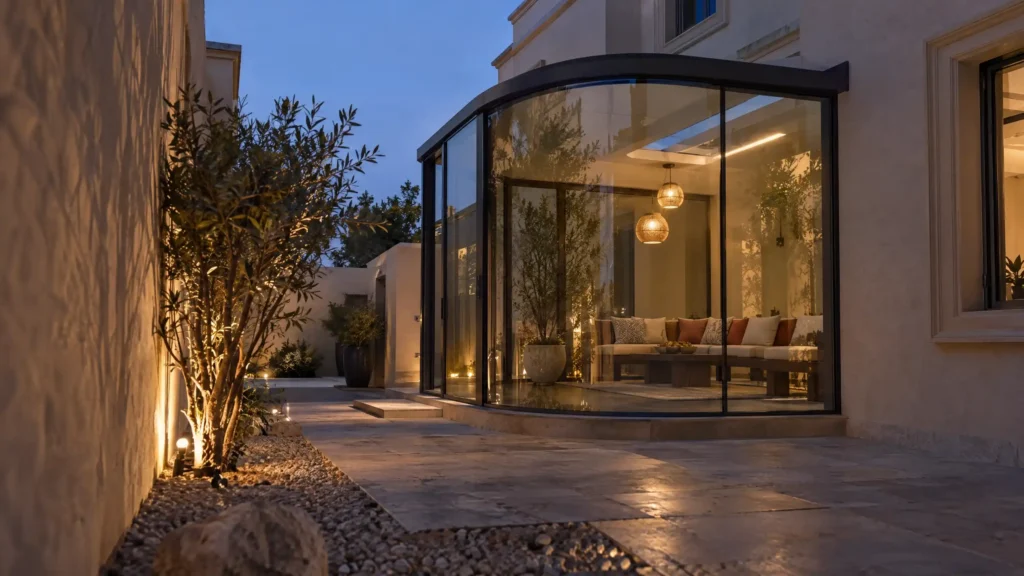
A custom glass room in Sharjah is a permanent outdoor villa extension built using thermal-break aluminium frames and double-glazed solar-control glass, requiring formal structural approval from the Sharjah Municipality.
Any structural villa extension in Sharjah requires an official building permit from the Sharjah Municipality before construction begins. You cannot simply pour concrete and erect glass walls on your property.
If you live in a master-planned community like Masaar, Aljada, Tilal City, or Al Zahia, you also need a No Objection Certificate (NOC) from the master developer. Do not hire a contractor who tells you to handle the paperwork yourself or advises you to skip this step. The municipality regularly patrols neighbourhoods like Al Rahmaniya and Al Tai. Building without approval results in heavy fines and a mandatory demolition notice.
Your contractor should manage this entire paperwork process for you. They need to submit the following items to the authorities:
A professional glass room company factors the NOC fees and structural drawing costs into their initial quotation. They will not start fabrication until the municipality stamps the final approval.
The type of glass your contractor installs dictates whether you can actually sit in the room during August. You must ask for double-glazed Low-E (Low Emissivity) glass.
Standard single-pane glass, or even basic double glazing, allows too much solar radiant heat to pass through the walls. Low-E glass features a microscopic metallic coating that reflects infrared heat back into the environment while still letting visible light inside. This drastically lowers the Solar Heat Gain Coefficient (SHGC) of your room.
For the best results in the UAE, the glass panels should feature a 6mm outer pane, an argon gas-filled spacer, and a 6mm inner pane. The argon gas acts as a dead zone that slows down heat transfer. Ask your contractor for the specific U-value of the glass they quote; the lower the number, the better the glass blocks the Sharjah heat.
High-quality glass means nothing if the metal frame holding it acts as a radiator. You must verify that the contractor uses thermal-break aluminium profiles for the wall and door structures.
Aluminium is a highly conductive metal. If the frame gets hot on the outside, that heat travels straight through the solid metal and radiates into your air-conditioned room. A thermal-break profile solves this problem by splitting the aluminium frame into two separate exterior and interior pieces.
The manufacturer joins these two pieces using a polyamide plastic strip down the middle. Because plastic does not conduct heat well, the outside frame can bake in the 48°C sun while the inside frame remains cool to the touch. Specify heavy-duty extruded T6 aluminium in your contract to guarantee structural stability against strong Shamal wind loads.
Cooling a space made entirely of glass requires completely different math than cooling a standard concrete bedroom. A contractor must calculate the high-ambient cooling load required specifically for a glass enclosure.
Standard AC tonnage calculations will fail. If a contractor estimates your cooling needs just by looking at the square footage, they are guessing. Because glass inherently absorbs more heat than concrete, a glass room requires roughly 1.5 times the BTU (British Thermal Unit) capacity of a normal room. Furthermore, the air conditioning units must feature T3 tropicalised compressors designed to function in extreme Gulf climates.
You also have to consider your power supply. Adding heavy air conditioning to a villa requires available electrical capacity. The contractor must check your main distribution board to confirm that SEWA (Sharjah Electricity, Water and Gas Authority) provides enough power to your plot to handle the new load. If your breaker trips every time the glass room AC turns on, you will face expensive electrical upgrades later.
Your glass room needs a roof that blocks the midday sun and keeps the winter rain out. You need to decide between a solid roof or a transparent skylight system.
An insulated sandwich panel roof is the most practical choice for the UAE climate. These thick panels block 100% of the overhead sun and offer the highest level of heat rejection. The contractor can then install a standard gypsum false ceiling underneath so it looks like a normal room inside.
If you prefer a clear view of the sky, you have other options to discuss with the installation team:
Regardless of the roof type, verify the sealing materials. The contractor must use high-grade EPDM rubber gaskets around all glass edges. Cheap silicone degrades under intense UV exposure within a year. Once the silicone cracks, water will leak into your majlis during heavy Sharjah winter rainstorms, and fine red desert sand will infiltrate the sliding tracks.
The UAE market is full of middlemen who sell services but outsource the actual work. You want to hire a direct fabrication company that owns a factory in the Sharjah Industrial Areas or the Al Sajaa Industrial Area.
When you hire a broker, they take a margin off the top and subcontract your glass room to the cheapest available workshop. This creates massive communication gaps. If a glass panel arrives with the wrong dimensions, a middleman has to argue with their supplier to get it fixed, delaying your project by weeks.
A direct manufacturer takes on-site laser measurements and fabricates the aluminium profiles and glass panels on their own machines. This keeps the pricing transparent and speeds up the installation. Ask the contractor for the physical location of their factory. A reputable company will gladly invite you to their workshop in Industrial Area 13 or 17 to see the materials before you sign the agreement.
Never accept a vague, one-page quotation that simply states a total price for “One Glass Room.” A professional proposal breaks down the exact specifications, materials, and scope of work.
You need to know exactly what the price per square metre (AED/sqm) covers. Many homeowners get caught off guard by hidden civil works that the contractor verbally implied were included.
Before paying a deposit, check the contract to see if it covers the following supporting tasks:
Finally, demand a written warranty. A reputable Sharjah contractor will provide a 5 to 10-year warranty on water leakage and structural integrity. They should also guarantee the frame’s powder coating against peeling or fading in the sun, ideally using the international Qualicoat standard.
Yes, any structural villa extension in Sharjah strictly requires a Municipality permit and potentially a developer NOC.
Not if engineered properly with thermal-break aluminium frames, double-glazed Low-E glass, and a dedicated T3 air conditioning unit.
Quality glass enclosures in Sharjah range from AED 650 to AED 1,500+ per square metre depending on the insulation and roof type.
Following permit approvals, factory fabrication takes 10 to 14 days, with on-site installation taking roughly 2 to 4 days.
An insulated sandwich panel roof blocks the most heat, while laminated safety glass is required if you want a transparent skylight.
Tempered glass works best for vertical sliding walls, but laminated safety glass is strictly mandatory for all overhead roofing.
Yes, contractors can install PDLC smart glass that turns from clear to opaque at the press of a button for instant privacy.
Building a glass room adds immediate lifestyle value and square footage to your Sharjah property, provided you hire the right team. Do not rush the hiring process. Whether you specifically want Glass Rooms Sharjah Elegant Rooms or another local supplier, make a shortlist of three direct fabricators. Ask them specifically about their thermal-break profiles, Low-E glass specs, and municipality permit process.
Your next step is to invite these contractors to your villa for a site inspection. Ask them to perform a laser measurement of the space and evaluate your current electrical board. Request an itemised quotation based on those exact measurements so you can compare their prices and materials side by side.