
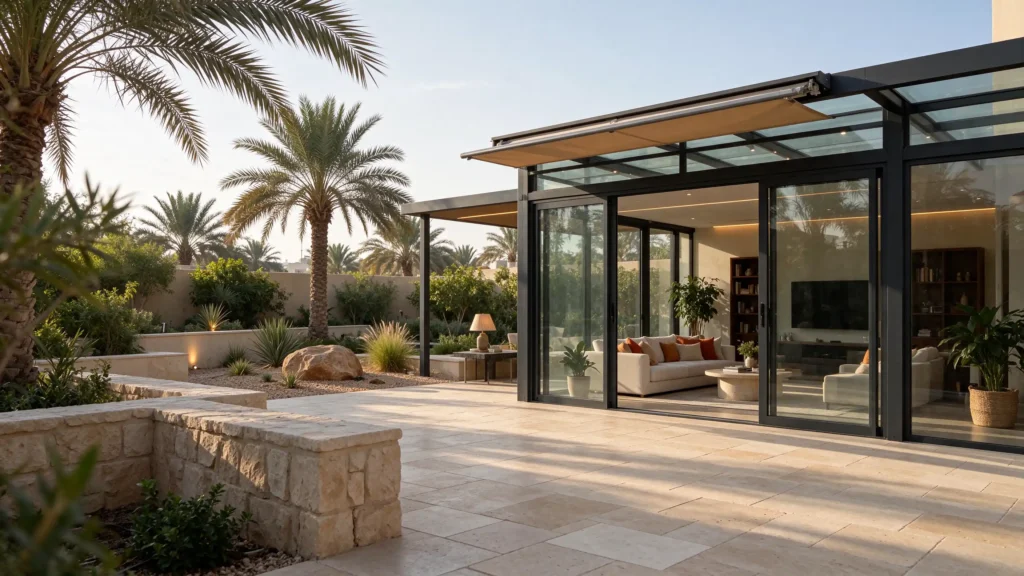
A glass room can turn an unused villa garden into a bright lounge. But when temperatures reach 45°C, the wrong design becomes an expensive greenhouse.
Glass rooms in the UAE can work year-round if owners plan for heat, dust, safety, cooling and approvals before ordering materials.
A good specification depends on how often you use the room and which direction it faces.
A glass room has glazed walls, a supporting frame and a roof, often attached to a villa or placed in a garden. Doors may slide or fold open.
People use them as garden conservatories, offices and poolside lounges. Palm Jumeirah homes may need salt-resistant hardware; Khalifa City villas may need more shade and dust protection.
Small enclosures may start around AED 15,000, while insulated custom rooms can exceed AED 100,000. Some quotations cover only glass and frames; others include roofing, foundations and cooling.
Project type | Indicative overall budget |
Small basic enclosure | AED 15,000–30,000 |
Standard garden or villa room | AED 30,000–60,000 |
Premium insulated room | AED 60,000–100,000 |
Large bespoke luxury room | AED 100,000+ |
These are planning estimates, not verified market averages. Difficult access and complex roofing can increase costs.
Some suppliers advertise AED 1,800–6,000 per square metre. At AED 2,500 per square metre, a 12 m² room would cost AED 30,000 if priced by floor area.
Others price wall and roof glazing separately, so check the measurement basis.
Before comparing quotations, request an itemised breakdown covering:
Compare completed project costs, not headline rates.
Also ask whether the quote includes making good the villa wall after installation. Cutting into existing surfaces may affect waterproofing, drainage or outdoor tiles. A clear scope should explain who repairs these areas if problems appear. This matters especially when a room connects directly to the main house.
Solar-control Low-E double glazing suits many air-conditioned rooms. Low-E means low emissivity: its coating helps reduce radiant heat transfer. Double glazing separates two panes with a sealed insulating space.
Toughened glass is heat-treated for strength; laminated glass holds fragments with an interlayer. Neither term alone describes heat performance.
Compare solar heat gain coefficient (SHGC), which measures admitted solar energy, and U-value, which measures heat transfer. Lower values generally mean less unwanted heat. Request complete unit specifications.
For daily use facing west, solar-control insulation matters more than for an occasional-use shaded enclosure.
Yes, but AC capacity alone cannot overcome uncontrolled sunlight, air leaks and an exposed roof.
An HVAC engineer should calculate cooling load before you choose split or ducted AC. Two 20 m² rooms need different cooling if only one has an exposed glass roof.
An indoor target of 22–24°C requires a design based on sun exposure, occupants and ventilation, not guesswork.
External shades block sunlight before it hits glass. Insulated roof panels reduce exposure, while thermal-break aluminium frames limit heat transfer through the metal.
Tight doors help too. Actual DEWA bills still depend on use, tariffs and AC efficiency.
Roof direction deserves a separate conversation. A large west-facing glass roof receives strong afternoon sun when many households want to use the room. If the view is the main priority, keep the glazing where it matters most and use fixed shade over less important areas.
Overhead glazing must protect people below. The Dubai Building Code requires laminated overhead glass with post-breakage containment to retain broken material.
Toughened glass alone cannot provide the same retention. An engineer must specify roof panels, spans and fixings.
Request wind-load calculations and drainage plans. Never choose 8 mm, 10 mm or 12 mm roof glass based only on appearance.
Fine sand enters through poorly sealed tracks, corners and roof joints.
EPDM rubber gaskets, compression seals and interlocking tracks reduce dust and wind noise, although no opening is completely dustproof.
Check drainage direction, request wind and water performance details, and clarify replacement of worn seals.
Extensions often need approval because they change exterior appearance or structure. Requirements vary by site.
Emaar, Nakheel and DAMAC communities may require a developer no-objection certificate (NOC). Government permission can come from Dubai Municipality, Dubai Development Authority or another relevant authority.
A developer NOC does not replace a required government permit. Confirm who submits drawings and obtains approval.
Abu Dhabi’s Department of Municipalities and Transport (DMT) offers a simplified process for eligible residential extensions up to 25 m². Approval is still subject to conditions.
Check developer consent in Yas Island or Al Reem Island, and relevant municipality rules in Sharjah.
Keep digital copies of approved drawings, permission letters and contractor documents. These records can help during inspections, later maintenance or a property sale. If an installer says that a permanent enclosure needs no paperwork, ask them to confirm that claim with the authority responsible for your plot.
A site survey should check levels, drainage, existing walls, services and door clearance.
A practical project sequence is:
On-site assembly may take days, but approvals and fabrication can take weeks. Get a written schedule and warranty.
Design for daily use: offices need glare control; lounges need comfortable temperatures; poolside rooms need humidity-resistant hardware.
Frameless systems provide wide views but still need structural support. Fluted or bronze-tinted glass adds privacy. PDLC switchable glass changes transparency electrically; it is not a substitute for solar control.
Check smart glass temperature limits and warranties. An insulated roof often suits hotter, exposed plots.
Rinse sand before wiping to avoid scratches. Clean tracks and gutters, inspect seals, and maintain coastal hardware near Dubai Marina.
Hydrophobic and self-cleaning coatings may reduce buildup but do not eliminate cleaning. Follow manufacturer instructions.
Yes, a properly designed glass room can be used throughout the year. The key is controlling solar heat through glazing, shading and insulated framing, then selecting AC from a cooling-load calculation. A simple single-glazed enclosure without adequate shade may feel uncomfortable in peak summer, even when it looks attractive in winter.
Possibly, but balcony enclosures often affect the building façade, safety provisions and shared-property rules. Get written guidance from the building manager and the responsible authority before ordering panels. The existing balcony must also be checked for structural suitability. An approval granted for a villa extension does not apply automatically to an apartment.
Aluminium is common for large glazed openings because it can support slim profiles and suitable structural systems. Thermally broken aluminium improves insulation compared with basic metal frames. uPVC may perform well in suitable designs, but check span limitations, frame dimensions, weather resistance and the supplier’s tested system rather than choosing solely by material name.
PDLC smart glass mainly changes privacy by switching between transparent and translucent states. Its ability to reduce solar heat depends on the full glass construction and any additional coatings. For a sunny roof or west-facing wall, ask for SHGC and U-value data instead of assuming an electrical privacy feature will solve the cooling problem.
A well-built, permitted glass room may make a property more useful and appealing, but there is no guaranteed return on investment. Buyers may question an unapproved extension or high running costs. Keep permits, product specifications and warranties, and compare the expense with other improvements before treating the project as a financial investment.
The main structure can remain serviceable for many years when it is correctly designed, installed and maintained. Its useful life depends on corrosion protection, weather exposure, hardware quality and cleaning. Sealants, rollers and gaskets may need attention earlier than the aluminium frame, so ask the installer about replacement parts and warranty exclusions.
A Glass Room in the UAE is worth considering when it adds useful space without creating excessive cooling or maintenance costs. Compare specifications, not just prices.
Start with a site survey, an itemised quote, performance data and written approvals. That is how a beautiful room becomes practical year-round.